

Key Takeaways
- Shimming a large aerospace fixture by hand runs roughly 10 minutes per point across eight points. SCHUNK’s system does the same job in 5 to 10 seconds.
- A part that took eight operations in legacy workholding now takes four.
- The underlying problem is residual stress. Thin-walled aerospace parts can have over 90 percent of the billet machined away, and the stresses locked in during forging release as the material comes off.
- A Boeing figure still cited in current literature put distortion-driven rework and scrap at $290 million across four aircraft types.
- Soltmann reports a sharp swing toward aerospace and defense over the past two to three years, with legacy manufacturers replacing fixtures they had run for decades.
Aerospace workholding is the least discussed constraint in precision machining. Spindle speed, tool life and controls get the attention. Meanwhile the part is held in place by a fixture that a skilled operator levels with hand-cut shims, and whether the finished component is in tolerance depends on how well he did that.
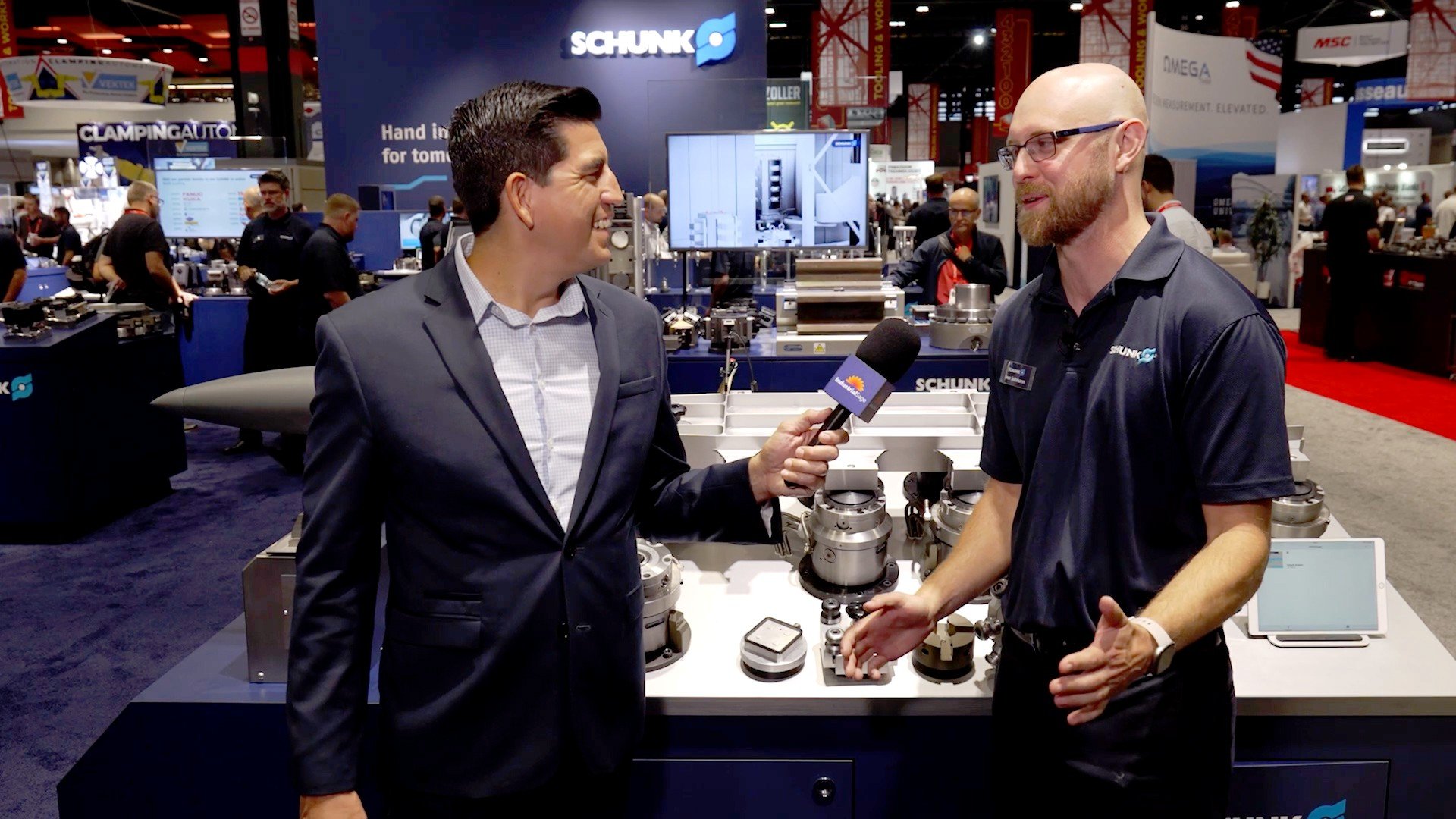
IndustrialSage sat down with Sven Soltmann, Senior Project Engineer at SCHUNK, on the show floor at IMTS 2026. Watch the full interview here.
The Part Moves When You Let Go of It
Soltmann was demonstrating the VERO-S aviation system, designed for large structural aerospace components. The problem it addresses is not obvious until you have watched it happen.
“Mainly they’re having problems with part deformation. When you remove a lot of material and you unclamp a part, they want to move.”
The cause is locked into the material before a tool ever touches it.
“It’s due to the internal stresses. Whenever you create a billet or a forging, you create internal stresses as the part cools and it goes through the forging process. So you never know what the internal stresses are going to be. It’s always different part to part.”
The engineering literature backs this up and adds scale to it. Residual stresses are introduced by forging, casting, heat treatment and additive processes, then redistribute as material is removed. Thin-walled aerospace structures are especially exposed because more than 90 percent of the billet can end up as chips, which strips the part of the rigidity that was resisting the stress in the first place. Cutting heat and tool loads then introduce a second layer of stress at the surface.
The cost is not theoretical. A Boeing assessment, still referenced in current reviews of the problem, attributed $290 million in rework and scrap to residual-stress distortion across four aircraft programs. That number is from 2001 and the industry has not stopped machining monolithic parts since.
Aerospace Workholding That Lets the Part Move First
Conventional aerospace workholding fights the distortion: clamp harder, flip the part, take lighter cuts, measure and compensate. SCHUNK’s approach inverts it.
“At its very heart we’ve got our VERO-S. This is our zero point quick change system. We’ve got five micron repeatability. We’ve taken it a step further here with the aviation system and mounted it to these flexible risers that can actually move X, Y, Z. They float, so that way when we relax the part, the part will pull this in whatever position it needs to go. We reclamp it, and the part is now clamped in its stress-free state, and then we can machine it flat again.”
Rather than predicting how a given forging will deform, the fixture lets the part tell it. That matters because, as Soltmann says, the stress state varies part to part and is effectively unknowable in advance without characterizing each blank. A system that responds to the actual part does not need to.
Eighty Minutes of Shimming
The time saving is where the argument stops being technical and starts being commercial.
“Shimming is kind of a skilled operator sort of process. Everyone’s going to do it a little differently, so it’s never going to be reliable in the same manner.”
Then the arithmetic.
“Usually the shimming process, someone would have to shim each one of these spots independently. It might take them five, 10 minutes to shim it, check it, reshim it, bolt it down. So you can imagine 10 minutes per, there’s eight on this part, so that’s 80 minutes right there. Versus hit the button, wait five seconds, hit the button, and you’re done. So we’ve gone from 80 minutes to five, 10 seconds.”
Two things are happening in that comparison and only one of them is speed. The other is variance. Hand shimming is a skilled judgment repeated eight times by a person who will not perform it identically twice, and who may not be the same person next shift. Replacing it removes a source of part-to-part variation that no amount of spindle precision downstream can recover.
The operation count moves too.
“Generally a part like this in traditional legacy work holding would take like eight operations. You flip it, machine it, flip it, machine it, and now we can do it in four operations.”
Every flip is a re-fixture, and in aerospace workholding every re-fixture is another chance to introduce error. Halving them compounds with the shimming saving rather than simply adding to it.
Why Aerospace Is Replacing Workholding Now
Asked whether inquiries have picked up, Soltmann is unambiguous about both the direction and the timing.
“I’ve been with SCHUNK about five years. I would say the past two to three years we’ve noticed a huge uptick, like a huge swing in the business into the aerospace and the defense side.”
And the specific behavior behind the swing.
“A lot of the legacy aerospace manufacturers are updating their fixtures, which are really antiquated, old school, toe clamping stuff down, and they’re moving to this more modern solution.”
That is the detail worth noticing. These are not new entrants buying their first fixtures. They are established manufacturers replacing tooling that worked well enough for decades, which only happens when volume rises far enough that the old method’s hidden costs stop being absorbable. Eighty minutes of shimming is tolerable at low rate. It is not tolerable when the schedule doubles.
It is the same mechanic we have documented elsewhere in the industrial base, where demand exposes a constraint nobody was measuring, from gas turbine capacity to the welder shortage.
A Small Part in Launching All of These Rockets
Asked what he is proudest of, Soltmann goes to space rather than aviation.
“We’ve done a lot in the rocket industry lately. The Artemis missions, launching people around the Moon. We’ve got a new focus on Mars and the Moon right now. I’ve worked on a lot of the projects with all of the legacy rocket makers, the new startups. So I’ve got a small part in launching all of these rockets, which I’m really proud of.”
And when asked how that feels, an answer that explains why people stay in this industry.
“I’m on team space. I don’t really care who it is. As long as we’re going to space, I’m happy.”
More from the show floor: the full From the Floor series from IMTS 2026.
About SCHUNK
SCHUNK manufactures workholding and automation components, including lathe chucks, grippers, and the VERO-S zero point clamping system, for part handling, holding and machining across industrial and aerospace applications. Learn more at schunk.com.
Frequently Asked Questions
Why do aerospace parts distort during machining?
Forging, casting and heat treatment lock residual stresses into a billet. As material is removed those stresses redistribute and the part moves. Thin-walled aerospace structures are most affected because over 90 percent of the billet can be machined away, removing the rigidity that was holding the stress in balance.
What does machining distortion cost the aerospace industry?
A Boeing assessment still cited in current engineering reviews attributed roughly $290 million in rework and scrap to residual-stress distortion across four aircraft types. The figure dates from 2001, and monolithic machined structures remain standard practice.
What is a zero point clamping system?
A zero point system provides a repeatable mounting interface so fixtures and parts can be swapped on and off a machine without re-indicating position. SCHUNK’s VERO-S offers five micron repeatability, which is what makes quick change viable on precision work.
How does floating workholding handle residual stress?
The fixture is mounted on risers that can move in X, Y and Z. The part is unclamped and allowed to relax into its natural stress-free shape, the risers follow it, and the part is then reclamped in that position and machined flat. Rather than predicting distortion, the fixture responds to the actual part.
How much time does automated clamping save over shimming?
Sven Soltmann of SCHUNK describes hand shimming as roughly 10 minutes per clamping point, about 80 minutes across eight points on a large part, versus 5 to 10 seconds with the automated system. Operation count on a comparable part drops from eight to four.
Why are aerospace manufacturers replacing workholding now?
Soltmann reports a sharp swing into aerospace and defense over the past two to three years, with established manufacturers replacing antiquated toe-clamping fixtures. Rising production rates make the hidden cost of manual setup, which was absorbable at low volume, no longer tolerable.

Author: Wes Garrett
Content and Growth Marketing Producer | From Strategy to Execution, Delivering Impactful Media Solutions and Client Success


