

Key Takeaways
- Agentic robot programming moved from slideware to a live demo at IMTS 2026. A plain-language instruction produced working Python in about eight seconds.
- The generated code ran in a digital twin first, then deployed to the physical cell. Nobody tested an agent’s output on live hardware.
- On real machines, Vention reports programs that took one to two weeks of development now taking two to three days.
- Design, programming and simulation on the platform are free. Revenue comes from hardware, not software licenses.
- Sterne’s thesis: the future of no-code is not drag and drop, it is agents, and that makes the digital twin more necessary rather than less.
Agentic robot programming has an obvious objection attached to it, and the people selling it rarely address the objection in public. If a language model writes the motion program, what happens the first time it is wrong and the machine is real?
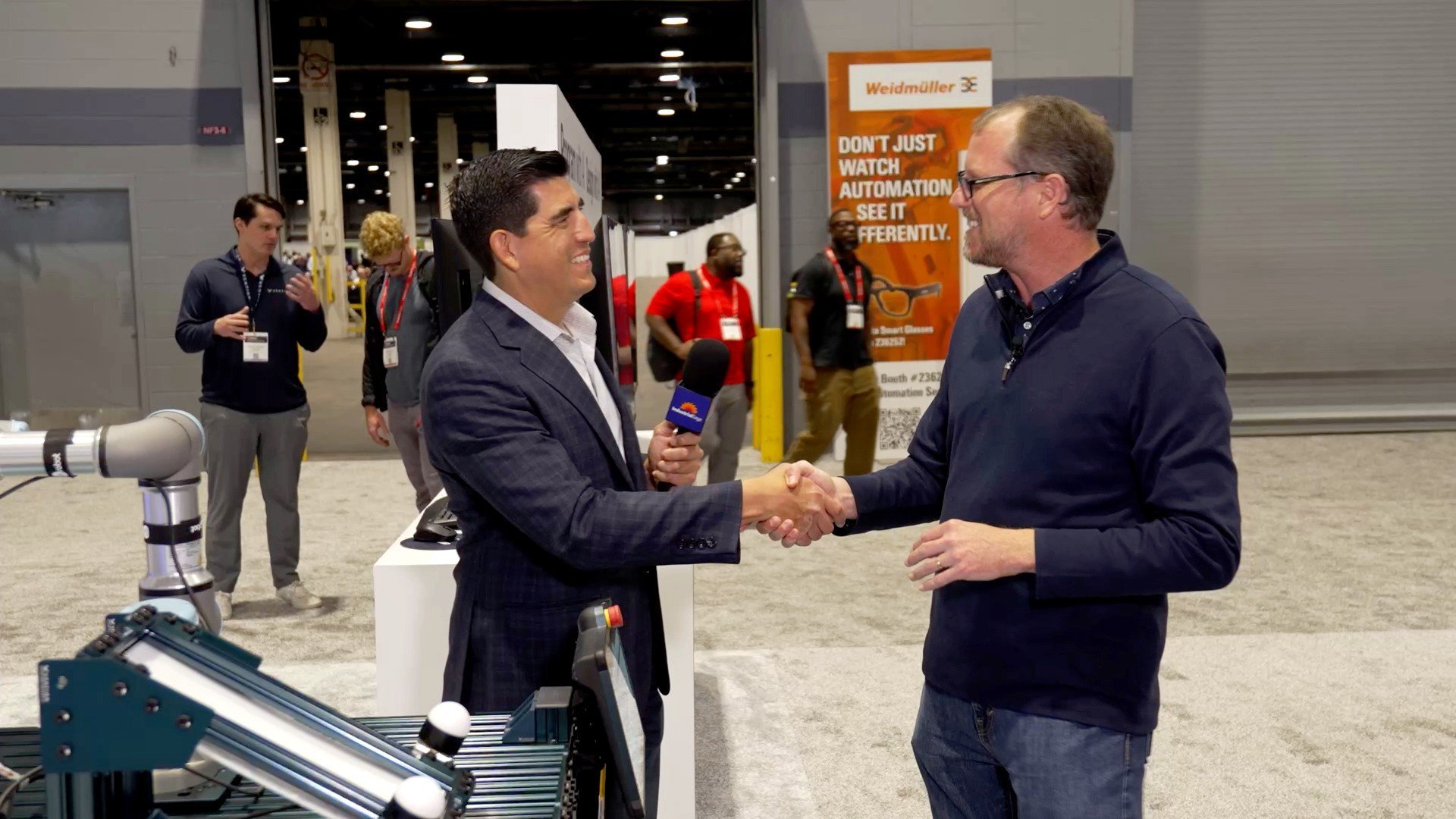
IndustrialSage sat down with Brendan Sterne, Chief Product Officer at Vention, on the show floor at IMTS 2026. Watch the full interview here.
What Vention Actually Is
Before the demo, the shape of the platform matters, because it explains why the agent has something solid to write against.
“We are an all-in-one industrial automation platform. We’ve got our hardware, we’ve got our software. Anyone can go in a browser, go to vention.com. They can design an automation cell with gantry motion, rotary motion, robots. They can program it in the browser. We’ve got a digital twin. They can validate it, and if they like what they’ve designed and programmed, they can order it assembled or flat pack and they can assemble it themselves.”
Danny reached for an analogy and Sterne improved on it: motion Legos, but for adults. The useful part is that the catalog, the CAD, the control code and the simulation all describe the same objects. An agent generating code for that system is not guessing at a plant it cannot see.
The Demo, Run Live
Vention’s announcement at the show was Machine Agent, and Sterne offered to run it on the spot rather than show a recording.
“What you’re seeing here is this is just a browser. We’ve got some candy on the little conveyor, and what we’re gonna do is we’re going to use our copilot inside the browser and it’s gonna write the program for us, and this is a digital twin of the cell that’s right behind you.”
Danny typed the instruction in conversational English, including an ad-libbed “drop it like it’s hot,” which the system handled without complaint. Then the part worth paying attention to.
“You saw about eight seconds there. Here’s the Python it generated. It’s using our APIs and SDKs, so this is a real program.”
Eight seconds to a real program, not pseudocode. The cell then homed its axes, picked the candy, and dropped it on the slide. The interviewer, who says plainly that he does not know Python, had just programmed an industrial machine.
Why the Digital Twin Matters More, Not Less
This is the line that separates the demo from a party trick, and Sterne volunteered it without being pushed.
“If you’re using agentic to program, it sure is handy to have a digital twin. ‘Cause you don’t want to test the agent’s program right on a live machine first.”
Most of the industry conversation treats simulation as the thing AI will eventually make unnecessary: if the model is good enough, why rehearse? Sterne argues the opposite, and the argument holds. A human programmer’s errors are usually conservative and legible, because the person understood what they were attempting. A generated program can be confidently, fluently wrong in a way that looks correct on the page. The faster you can produce programs, the more you need a place to run them that does not have mass.
So the sequence is deliberate: agent writes, twin validates, machine executes. The twin is not a legacy step the agent routes around. It is the component that makes the agent safe to use.
What It Does on Real Machines
A candy conveyor is a demo. The claim that matters is about production work.
“We actually have very large, sophisticated machines where our engineers and our customers are using agentic programming to help design the programs. And we’re seeing programs that used to take a week or two of development time be done in two or three days.”
Roughly a threefold compression, and notably not a claim of elimination. The engineer is still in the loop, still reviewing, still responsible. What has gone is the portion of the work that was transcription from intent into syntax.
That distinction matters for how shops should evaluate this. The saving is not in the thinking. It is in everything that surrounds the thinking.
The Future of No-Code Is Not Drag and Drop
Sterne’s broader position is a direct swipe at a decade of industrial software convention.
“They talk about no-code environments where people don’t need to code, and usually they’re talking about visual drag and drop. I think the future of no code is agentic-based stuff. So they’re gonna interact with an agent. Then they need to validate it in the digital twin, if it looks good, to the real physical machines.”
Visual block editors were always a compromise. They lowered the barrier to simple tasks while making complex ones harder than writing code, because expressing a nested condition by dragging boxes is worse than typing it. An agent removes that ceiling. You describe intent at whatever complexity you like, and the output is text a competent engineer can read and correct.
It is the shift we heard repeatedly on the floor, and it is not that robots are getting smarter. The intelligence is arriving from outside them. Vention is describing what that outside system looks like when a person is holding it.
Free Until You Buy Metal
The commercial model is unusual and worth stating because it shapes who can try this.
“Doesn’t cost you anything. Anyone can sign up. Go to vention.com, create an account. You can design a machine or use existing ones. You can program them. You don’t pay anything. There’s no software license. You only pay if you buy one of these beautiful machines.”
Software revenue would require gating the design tools, which would mean fewer people designing cells. Putting the revenue on hardware means the evaluation costs an engineer an afternoon rather than a purchase order, which for small shops is the difference between assessing automation and continuing to think about it.
More from the show floor: the full From the Floor series from IMTS 2026.
About Vention
Vention is an all-in-one industrial automation platform combining browser-based cell design, programming, digital twin simulation and manufactured hardware, shipped assembled or flat-packed. Its Machine Agent adds agentic programming to the platform. Learn more at vention.com.
Frequently Asked Questions
What is agentic robot programming?
It is describing a task to an AI agent in plain language and having it generate the robot’s control program, rather than writing code or assembling visual blocks. In Vention’s demo at IMTS 2026, a conversational instruction produced working Python against the platform’s own APIs in roughly eight seconds.
Is it safe to let an AI write a robot program?
Only with validation in between. Vention’s sequence is agent writes, digital twin validates, physical machine executes. As Chief Product Officer Brendan Sterne puts it, you do not want to test the agent’s program on a live machine first. Generated code can be fluently wrong in ways that look correct, which makes simulation more important rather than less.
How much time does agentic programming actually save?
Vention reports that programs previously requiring one to two weeks of development are being completed in two to three days on large, sophisticated machines. The engineer remains in the loop reviewing output. The saving is in translating intent into syntax, not in the engineering judgment.
How is this different from no-code visual programming?
Visual drag-and-drop editors lower the barrier for simple tasks but make complex logic harder to express than writing code. An agent removes that ceiling, since intent can be described at any complexity and the output is readable text an engineer can review and correct.
Why is a digital twin necessary for AI-generated programs?
Because the faster programs can be produced, the more you need somewhere to run them that has no mass. The twin catches collisions and logic faults before any hardware moves, and it is the component that makes rapid agent-generated programming safe to deploy.
What does Vention cost?
Designing, programming and simulating on the platform is free with no software license. Revenue comes from the hardware, so a shop can evaluate an entire automation cell before committing to a purchase.

Author: Wes Garrett
Content and Growth Marketing Producer | From Strategy to Execution, Delivering Impactful Media Solutions and Client Success


