

Key Takeaways
- Direct robot control is built into the CNC. An operator touches off teach points and the control emits a full G-code program, so no one on the floor has to know a robot language.
- Strache’s framing of what that changes: “you no longer need the ability to program a robot.”
- A vendor survey of more than 100 US plants put average vertical machining center spindle utilization at about 34 percent of in-cut time, against roughly 70 percent expected. Loading and unloading workpieces is named among the largest consumers of the rest.
- In AMT’s Top Shops benchmarking, top performers report a median spindle utilization of 75 percent against 65 percent for everyone else.
- The PortaSolutions machine in the booth runs three spindles and 16 axes, executing three synchronized part programs at once.
CNC robot programming is the quiet gatekeeper on shop floor automation. The arm is affordable, the gripper is a catalog item, and the business case for tending a machine through an unattended shift more or less writes itself. Then somebody has to teach the robot what to do, and in most shops that somebody does not exist.
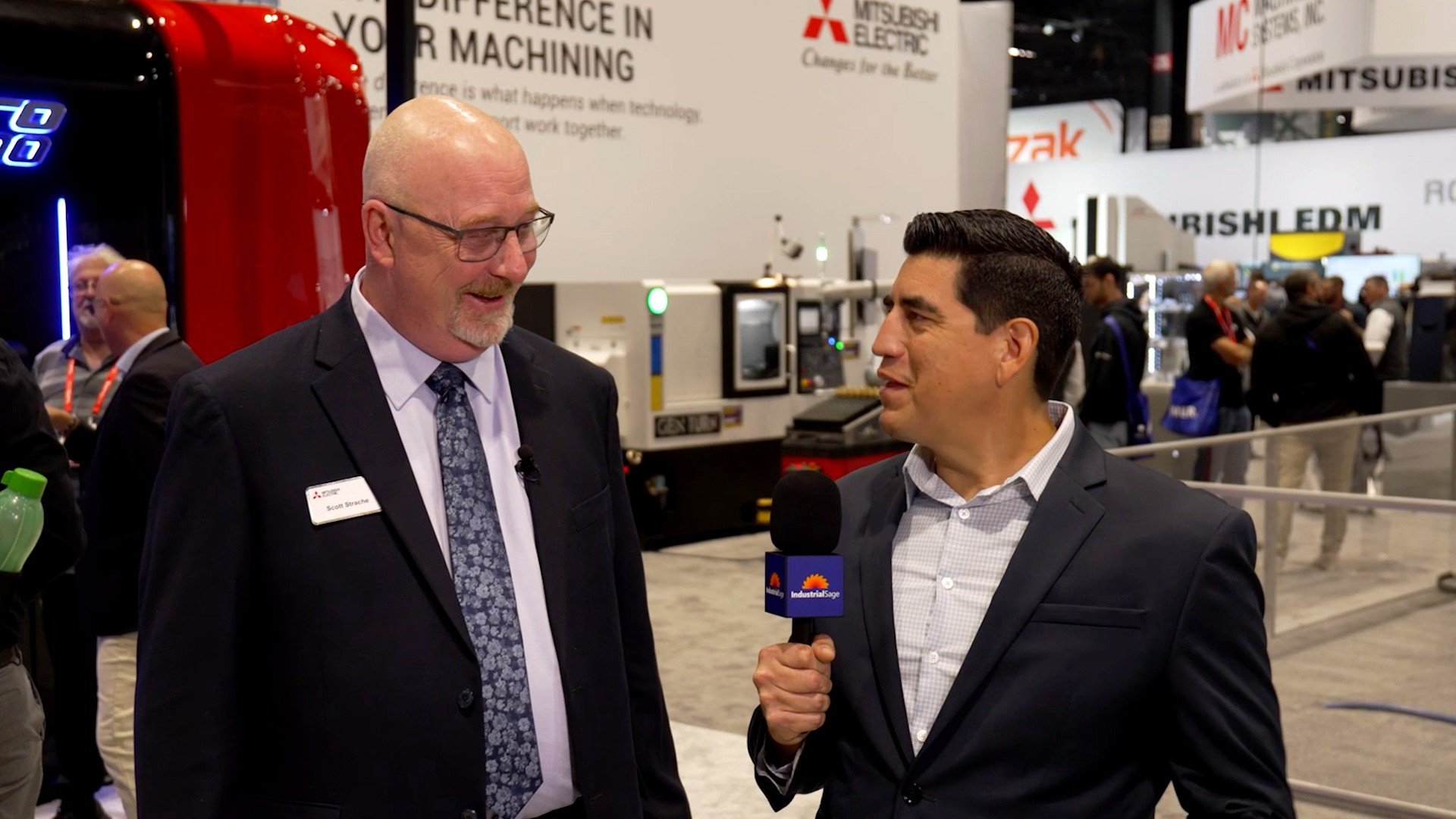
IndustrialSage sat down with Scott Strache, Senior Product Manager at Mitsubishi Electric, who runs the company’s CNC and robotic products, on the show floor at IMTS 2026. Watch the full interview here.
The Robot Was Never the Hard Part
Mitsubishi Electric sells the control on the machine tool and a good deal of what surrounds it. As Strache describes the lineup, the company offers “PLCs, GOTs, VFDs, general purpose servo and motion, and robotics.” That breadth is what makes the demonstration in the booth possible, because the robot and the control are not two vendors trying to meet in the middle.
“On one of our LoadMates in our booth, we’re actually talking through direct robot control that’s built into our CNCs, which allows an operator to take a robot and just touch off teach points. And it turns it into a fully G-code program. So you no longer need the ability to program a robot.”
Read that last sentence as a statement about hiring rather than about software. Robot programming has historically belonged to manufacturing engineers, specially trained staff and outside integrators. A shop with four machines and no engineering department does not have that person, and the robot sits unbought because of it.
What direct robot control does is change which language the task is written in. G-code is the language the shop already speaks. A machinist who can set up and prove out a part can touch off the points, and the control produces something they can read, edit and troubleshoot at two in the morning without calling anyone.
The integration problem does not vanish entirely. Getting a robot talking to a machine tool usually runs over an Ethernet connection, and plenty of shops still have not run one to the machine. But that is a cabling and IT problem with a known cost, which is a very different thing from a skills problem with no local solution.
What a Machine Tool Does When It Is Not Cutting
The reason machine tending is almost always the first robot a shop buys is visible in the utilization data, and the data is not flattering.
A machine tool builder’s assessment, drawing on a survey of more than 100 US plants, put average vertical machining center spindle utilization at roughly 34 percent of in-cut time against an expectation nearer 70 percent. The time goes to setup, tool maintenance, chip clearing, and loading and unloading workpieces. A separate trade analysis in 2022 put most shops in the 40 to 50 percent range and named tool management as the largest single source of idle time.
AMT’s own Top Shops benchmarking, run alongside IMTS, measures on a different base and so is not directly comparable, but the gap it finds between the leaders and everyone else is the interesting part: a median of 75 percent spindle utilization for top shops against 65 percent for the rest. Ten points of spindle time is a machine you did not have to buy.
Loading and unloading is the slice a tending robot takes directly, and it is also the slice that scales worst with people, because it happens every cycle and it happens at three in the morning or it does not happen at all. That is the arithmetic Strache is pointing at when he talks about output per person rather than output per machine.
“As you know today, in the workforce, there’s not a lot of trained operators anymore. So production facilities are looking at how they can increase their production, how they can increase their ROI with less people on hand.”
One Operator, More Than One Machine
The other half of the same problem is supervision. An operator who has to stand in front of a running machine to know what it is doing is an operator who cannot be anywhere else.
“Some of the new things we have with our M8V control is the built-in WiFi, which allows them to actually take an iPad and connect it up to the controller. So an operator can go in and work on other machines and still monitor the machine that’s running.”
Mitsubishi Electric introduced the M8V to North America in June 2026, built on the M80 platform, and reports roughly 11 percent faster machining than the previous series along with support for 3D machining simulation. The wireless connection is the less glamorous feature and probably the more consequential one for a small shop, because it changes the ratio of machines to people without changing the machines.
Three Machines in One Footprint
The largest piece of hardware in the booth arrived through a conversation at the previous show.
“Two years ago at IMTS 2024, I had actually talked to the company that built the machine behind us, PortaSolutions. About January of 2025, the president of Porta contacted us and asked if there was a way that we could show a brand new machine in our booth.”
What it does is a different answer to the same capacity question.
“If you think of it in raw terms, we’re taking three machining centers that would be on your production floor and combining them into one. So we have three spindles, we have 16 axes in the machine. But the biggest thing is our ability to do multi-system programming. So we can synchronously run three part programs at a time, meaning that there can be three operations going on and loading in a fresh billet. So your production level goes up without the ROI of having three machines on your floor.”
Three synchronized part programs is a control problem before it is a machine problem. Each system has to run its own program while staying aware of the other two, because the three spindles are working in shared space on a shared part. That coordination is where the control earns its place, and it is the same underlying capability that lets the CNC drive a robot without a separate controller in the loop.
It is also a floor space argument, which lands differently now than it did a few years ago. Capacity bought as a smaller footprint rather than another building is the same pressure we heard from other exhibitors wrestling with setup time on large parts.
What Strache Thinks Comes Next
Asked where this is heading, he puts it on the people rather than the products.
“The big thing today is AI, and I see not only a lot of our products merging into that in the future, but that’s really going to be the future of the next generation. How do they work with AI, and how do they become familiar enough with AI but still be in that manufacturing area, because that’s where we need the most help right now.”
That last clause is the honest part. The worry is not whether the technology arrives. It is whether the people who understand it stay on a shop floor, which is the same retention question behind the knowledge walking out the door everywhere else in the industry.
More from the show floor: the full From the Floor series from IMTS 2026.
About Mitsubishi Electric
Mitsubishi Electric Automation supplies factory automation products across CNC controls for machine tools, PLCs, operator interfaces, variable frequency drives, servo and motion control, and industrial robots. Learn more at us.mitsubishielectric.com.
Frequently Asked Questions
What is direct robot control on a CNC?
Direct robot control builds robot command into the machine tool control itself. An operator jogs the robot and touches off teach points, and the CNC turns those positions into a standard G-code program. The robot is driven from the same control and the same language as the machine, rather than from a separate pendant and programming environment.
Do you need a robot programmer to automate machine tending?
Not with a control that generates the program from taught positions. Robot programming has traditionally required manufacturing engineers or outside integrators, which is a real barrier for a shop with no engineering staff. Scott Strache of Mitsubishi Electric puts it directly: you no longer need the ability to program a robot.
What is spindle utilization and what is a typical rate?
Spindle utilization is the share of time a machine tool is actually cutting. One builder survey of more than 100 US plants found an average near 34 percent of in-cut time against about 70 percent expected, and a 2022 trade analysis put most shops at 40 to 50 percent. Definitions vary, so figures are only comparable on the same base.
What is multi-system programming on a machining center?
Multi-system programming lets one control run several part programs at the same time on the same machine, each driving its own spindle or group of axes while staying synchronized with the others. The PortaSolutions machine in Mitsubishi Electric’s IMTS booth runs three spindles and 16 axes on three synchronized programs.
What does built-in WiFi on a CNC control do?
It lets an operator connect a tablet to the control wirelessly and monitor a running machine from elsewhere on the floor. The practical effect is on staffing rather than on cutting: one operator can keep watch on a machine in cycle while setting up or running another.
Why is machine tending usually a shop’s first robot application?
Because loading and unloading happens every cycle, consumes a large share of the time a spindle is not cutting, and is difficult to staff on nights and weekends. It is repetitive, low skill and well defined, which makes it the easiest task to hand to a robot and the one with the clearest return.

Author: Wes Garrett
Content and Growth Marketing Producer | From Strategy to Execution, Delivering Impactful Media Solutions and Client Success


