

Key Takeaways
- A machine tool laboratory assessment put the average cost of replacing the components damaged in a collision at about $25,000, rising past $45,000 when the motor spindle cannot be saved.
- Collision damage is not preventable after the fact. Published research notes it can only be repaired reactively, which is why the cost shows up as both parts and downtime.
- One New England shop reported cutting manual prove-out time by as much as 80 percent after moving program verification into simulation.
- Siemens says its Meet at the Machine approach can cut machine ramp-up time by up to 50 percent, with programming starting before the machine has even been delivered.
- Asked whether reshoring is real, Strubel answers from the order book: primes and Tier 1 suppliers are buying a lot more controls, and more machine tools are arriving with Siemens controls on them.
CNC simulation software has spent most of its life being sold on insurance, as the thing that stops you from crashing a spindle into a fixture. That is a real benefit and the numbers behind it are worse than most shops admit. But it undersells what changes when the simulation is good enough to trust, because the expensive part of a new job was never the crash. It was the week of walking back and forth to the machine.
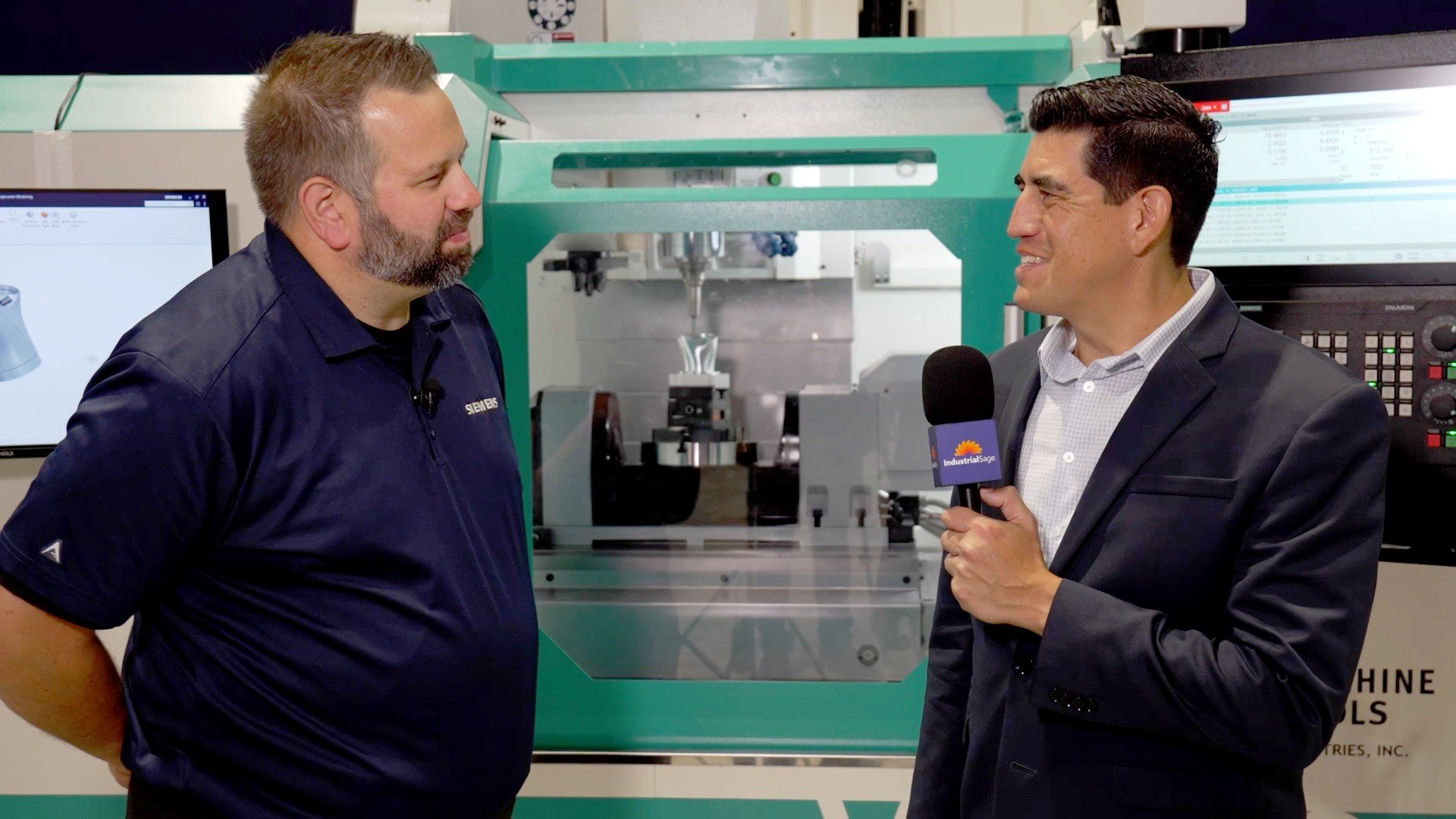
IndustrialSage sat down with Dan Strubel, Head of CNC Engineering at Siemens, on the show floor at IMTS 2026. Watch the full interview here.
What Meet at the Machine Actually Bundles
Siemens launched the initiative at IMTS. Strubel’s description of it is refreshingly unmarketed.
“Because we have all these different packages, we’ve bundled all that up into one package, and we’re gonna meet you at the machine so that you can download the software, download a post and simulation kit, and then you’re able to take your code and then post it out, and then go to the machine without having to worry that you’re gonna collide or anything.”
The significant word is “post.” A postprocessor is the translation layer between what the CAM system thinks the toolpath is and what the specific machine on your floor will actually do with it. It is machine specific, it is where a surprising share of first-article problems originate, and historically it has been something a shop sources separately, maintains itself, or pays someone to tune.
“One thing is, you didn’t have to piecemeal it. You didn’t have to go get the CAD, you didn’t have to go get the CAM, you didn’t have to go get the post, you didn’t have to go get the simulation.”
Siemens describes the wider initiative as a framework for co-developing machining solutions with machine builders, starting with a partnership with TRAK Machine Tools, and says the approach can begin while a machine is still being built, cutting ramp-up time by as much as 50 percent. That is the company’s own figure, and the mechanism behind it is simply that programming and validation no longer have to wait for delivery.
The Crash You Pay For Twice
The insurance argument deserves its numbers, because they are not small. An assessment from a machine tool laboratory put the average cost of exchanging the components affected by a collision at roughly $25,000. When the motor spindle itself is beyond repair, the same source puts it north of $45,000.
Published engineering work on the problem makes the harder point: collision damage cannot be designed out by the usual strategies and can only be fixed afterwards through reactive maintenance, which is what produces both the repair bill and the long machine downtime behind it. You pay once in parts and once in the weeks the machine is not earning.
What makes a simulation worth trusting against that is fidelity, and this is where Strubel draws the distinction.
“One of those things is having an ability to simulate really well, what we call high fidelity simulation, where we’re actually making sure that we have downloaded the brain of the control and put that on someone’s PC so that we can simulate it while this is running and making parts.”
Running the control’s own logic on the PC rather than a generic kinematic model is the difference between a simulation that approximates the machine and one that behaves like it. A generic model will miss the behaviors that actually cause crashes, which tend to live in the controller: how it handles a rapid after a tool change, how it interprets a canned cycle, what it does at the edge of an axis limit.
The second clause matters as much as the first. The simulation runs while the machine is cutting. The machine never stops to let you check your work.
The Back and Forth That Eats the Week
Here is the part that costs more than crashes, because it happens on every new job rather than on the rare bad day.
“In that case, what we’ve done is we’re giving you a tool that you sit at your desk and you simulate all that, and you simulate all the collisions, and you put it all in one, and then you go to the machine and you start running it. You don’t have to do all this back and forth from the machine to the CAM, to the machine, to the CAM.”
That loop is prove-out, and it occupies a machine that could otherwise be cutting while occupying the programmer at the same time. The published case studies point the same direction: one New England shop reported cutting manual prove-out time by as much as 80 percent after moving verification into simulation before the program reached the floor.
Treat the exact figure as job dependent, because it scales with part complexity and with how much of the program gets verified. The direction is the durable finding. Prove-out is one of the largest blocks of non-cutting time on a machine that a shop can actually attack with software, which puts it alongside setup and fixturing as a place where capacity hides. It is the same thinking behind eliminating hand shimming on large parts: the spindle is not the constraint, everything around the spindle is.
Strubel frames the whole product line that way.
“Every time we come out with a product, it is to decrease cycle time. Whether it be in CAD or CAM, whether it be in simulation, whether it be on the machine tool with probing cycles, we have something to decrease cycle time.”
Primes and Tier 1s Are Buying
Every exhibitor at IMTS was asked some version of whether reshoring is a real shift or a talking point. Strubel’s answer is among the more useful, because it comes from what is being ordered rather than from what customers say they intend.
“We’re seeing a lot more of machine tools coming in with our controls on it, because they want the high market. Primes and Tier 1s are buying a lot more of our controls, so we’re seeing the same thing as what you’re seeing.”
A control supplier occupies a useful vantage point here. Siemens does not sell the machine, so its volume is a read on what builders are shipping and what the end customer specified. When primes and Tier 1 suppliers are the ones pulling, that is capital equipment going into defense and aerospace supply chains rather than into general job shop capacity, which is a more specific signal than a rising headline order number.
On where it concentrates, he is broad with one exception.
“I think it’s broad, but if I had to pinpoint one of the ones that I’d say is just always gonna be there is defense and aerospace. I think it’s not going anywhere. Across the board, everything is kinda like high tide raises all boats.”
That matches what we heard elsewhere on the floor, where the demand showing up in order books is arriving as a change in what customers are asking shops to make, not simply as more of the same work.
Fifty Pallets and Six Machines
Asked what he is proudest of, Strubel describes a system rather than a product.
“I did a project where a customer could scan a part. The part would go away into a 50 pallet pool system, and it would choose between six different machines how to machine that. And then when it was done, it came back out. So all the operator had to do is just clamp the part, scan it, tell it what features they wanted to machine, and it would go away and make it.”
And why that one stuck with him.
“Because we married so many different technologies together. We married NX with CAM, and then we married it with simulation, and then we married it to the machine. So all these products got married together to make this kind of work all on its own without having to have any human intervention.”
It is the same argument as Meet at the Machine at a larger scale. The individual pieces were available to anyone. The value was in the integration, which is exactly the work most shops have neither the time nor the staff to do themselves.
More from the show floor: the full From the Floor series from IMTS 2026.
About Siemens
Siemens Digital Industries supplies SINUMERIK CNC controls, drives and motion hardware for machine tools, together with the CAD, CAM, postprocessing and simulation software around them. Learn more at siemens.com.
Frequently Asked Questions
What does CNC simulation software actually prevent?
Primarily collisions between the tool, holder, fixture and machine structure, caught before the program reaches the floor. A machine tool laboratory assessment put the average cost of replacing components damaged in a collision at about $25,000, rising past $45,000 when the motor spindle cannot be repaired, plus the downtime while the machine is out of service.
What is high fidelity simulation on a CNC?
A high fidelity simulation runs the machine control’s own logic on a PC rather than a generic kinematic model. Because the controller determines much of the behavior that causes crashes, from tool change rapids to canned cycle interpretation, simulating the real control gives results that match what the machine will actually do.
What is a postprocessor and why does it matter?
A postprocessor translates the toolpath a CAM system produces into the specific code a given machine and control will execute. It is machine specific and a common source of first article problems, which is why shops have traditionally had to source, tune or maintain one separately from their CAM package.
How much time does prove-out take on a new CNC part?
Enough that it is one of the largest blocks of non-cutting machine time a shop can address with software. One New England shop reported cutting manual prove-out time by as much as 80 percent after moving verification into simulation. Results vary with part complexity and how much of the program is verified.
What is Siemens Meet at the Machine?
An initiative Siemens launched at IMTS 2026 that bundles the CAD, CAM, validated postprocessor, simulation kit and digital CNC into one package, co-developed with machine builders starting with TRAK Machine Tools. Siemens says it can reduce machine ramp-up time by up to 50 percent, partly because programming can begin before delivery.
Is reshoring showing up in CNC control orders?
Dan Strubel, Head of CNC Engineering at Siemens, reports more machine tools arriving with Siemens controls and says primes and Tier 1 suppliers are buying a lot more of them. He describes demand as broad with defense and aerospace as the most durable segment.

Author: Wes Garrett
Content and Growth Marketing Producer | From Strategy to Execution, Delivering Impactful Media Solutions and Client Success


