

Key Takeaways
- One Hirebotics customer building data center infrastructure bought 2 welding robots in 2023. It now runs 73 across five US facilities.
- Data center construction is the company’s single biggest growth area, ahead of automotive and aerospace.
- The average US welder is in his late 50s, so the hiring problem compounds every year rather than easing.
- Hirebotics systems install in about an hour and a floor operator picks it up in 10 to 20 minutes, which is the part that matters when the alternative needs a robotics engineer.
- Typical payback runs a year to 18 months, per Hirebotics.
Data center welding automation has become the clearest demand signal in industrial robotics, and the reason is not the robots. It is that nobody can hire the welders.
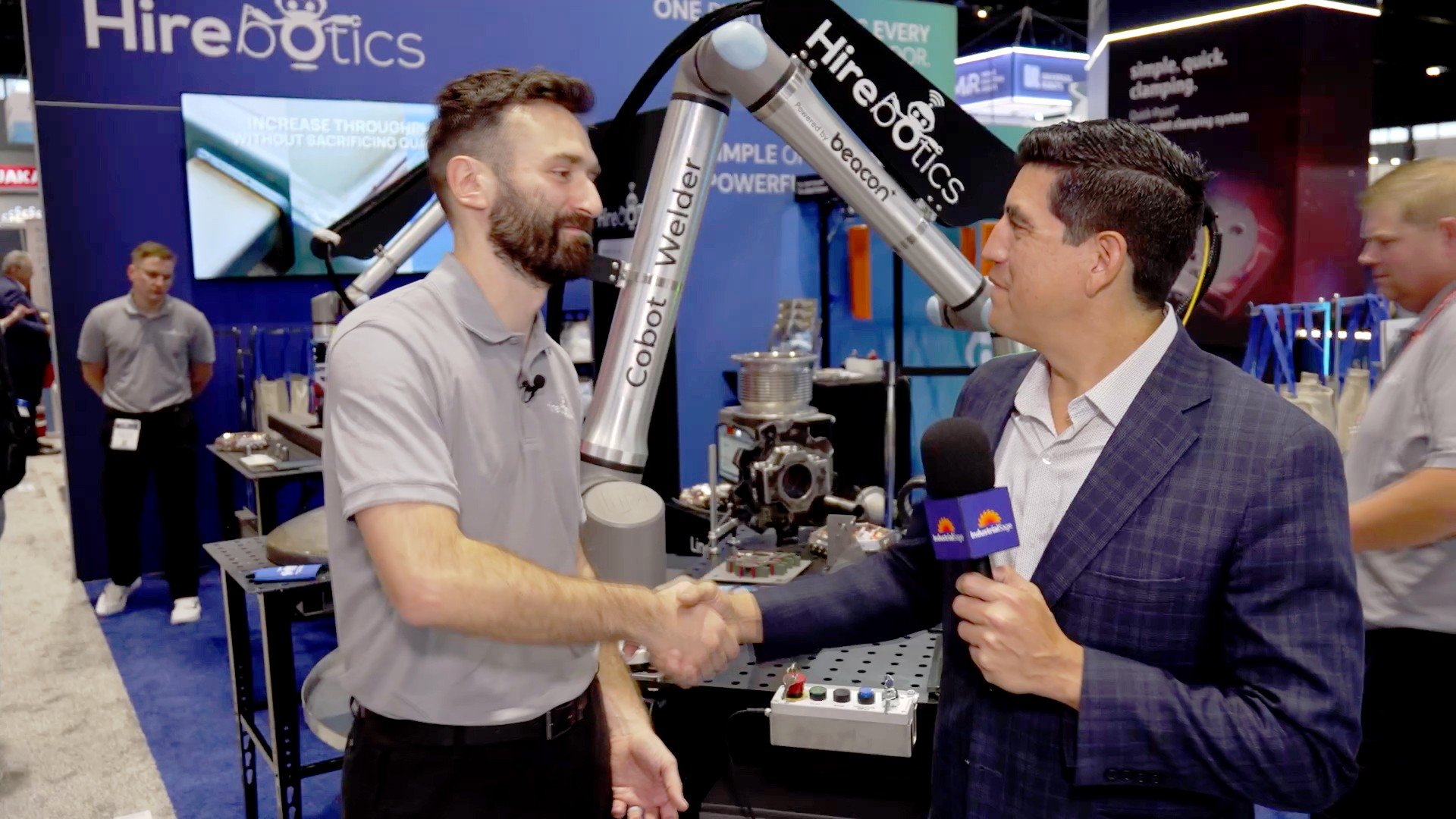
IndustrialSage sat down with Dan Adams, Director of Sales at Hirebotics on the show floor at IMTS 2026 to talk about what is actually driving adoption. Watch the full interview here.
From Two Robots to 73
Ask Adams where growth is coming from and he does not hedge.
“The biggest growth area for us is in data center construction. We have a customer that makes data center infrastructure. They bought their first two robots back in 23. They now have 73 robots across five different facilities in the United States.”
Two to 73 in roughly three years, at one company. That is not a pilot program maturing. That is a fabricator discovering it cannot meet demand any other way.
“They were just having a hard time keeping up with their demand. They have a lot of big customers that we’re all familiar with, constantly getting these orders and having a hard time to find people to weld, and now paint as well.”
The phrase worth sitting with is “big customers that we’re all familiar with.” The hyperscalers do not weld their own enclosures, skids or cable trays. That work sits with fabricators, and the order book arrived faster than the labor market could answer it.
Why Data Center Welding Automation Is the Pressure Point
This is the fifth constraint IndustrialSage has traced back to the same buildout, and the pattern holds every time. The bottleneck is never power in the abstract. It is a specific input nobody was watching.
We have reported on power transformer lead times at 128 weeks, on gas turbine manufacturing capacity with order books running toward 2030, on switchgear as the constraint on connecting a finished building to the grid, and on carbide and alloy recovery as the scarcity reached raw material.
Data center welding automation is the next one down the chain. Somebody has to fabricate the transformers, turbines and switchgear, and that somebody cannot find welders.
The Welder Math Does Not Improve
Adams frames the labor problem as structural rather than cyclical.
“It’s really hard to find people to do these skilled trades, specifically in welding. The average age of the welder in the United States is late 50s, so the problem’s getting worse. There’s huge labor shortages everywhere.”
An average age in the late 50s means the shortage deepens on its own, through retirement, regardless of how hiring goes. And the traditional escape route has its own version of the same trap.
“The decision used to be, do you keep trying to rehire or do you invest in traditional automation? Traditional automation takes a long time to set up, and you’re kind of trading who you’re trying to hire for. So you’re trying to hire robotics engineers, which are also hard people to find.”
That is the insight the category is actually built on. Conventional automation does not remove a hiring problem, it swaps a scarce welder for a scarce controls engineer.
An Hour to Install, Twenty Minutes to Train
Which makes deployment speed the product, more than the robot is.
“It’s an hour to install it, get it set up, and then you’re welding, painting, and cutting, same day.”
Operator training runs 10 to 20 minutes on the floor, which Adams credits to Beacon, the software Hirebotics built for its three applications. The flagship welding system handles everything from small parts to components 30 and 40 feet long, across aluminum, steel, stainless and copper. Welding came first in 2019, plasma cutting a couple of years later, and the painting cobot was the debut at IMTS 2026.
Where Cobots Beat Conventional Automation, and Where They Do Not
Adams is specific about the dividing line, which is more useful than a blanket pitch.
“A big challenge with traditional automation is that it’s really hard to change. So if you’re loading the same part into a fixture every day for the next five years, traditional automation can make a lot of sense. If you need to be flexible, if you need to do kind of high variety, lower volume kind of work, these cobots slot in perfectly, thanks to the low amount of programming time required.”
High mix and low volume is exactly the shape of data center fabrication, which is why data center welding automation landed on cobots rather than on fixtured cells.
The Shops That Could Not Automate at All
Asked what he is proudest of, Adams does not name the 73-robot account.
“Kind of why we got into it in the early days was helping the mom and pop that had a really hard time automating. They were very much caught in between trying to hire people, which is challenging, but also not having the expertise to program their own robots.”
For those shops the barrier was never the price of a robot. It was that buying one created a second job they also could not fill. Adams puts typical payback at a year to 18 months.
About Hirebotics
Hirebotics builds fully integrated cobot systems for welding, plasma cutting and painting, programmed through its Beacon software. Systems install in about an hour, and existing floor staff run them rather than robotics engineers. Learn more at hirebotics.com.
Frequently Asked Questions
What is driving data center welding automation demand?
Data center construction requires fabricated infrastructure such as enclosures, skids and cable trays, and fabricators cannot hire enough welders to keep pace with orders. Hirebotics reports data center construction as its single biggest growth area, including one customer that went from 2 welding robots in 2023 to 73 across five US facilities.
How many welding robots does a large fabricator actually deploy?
One Hirebotics customer producing data center infrastructure scaled from two robots in 2023 to 73 across five United States facilities, driven by order volume from large technology customers rather than by a labor-cost target.
Why is the welder shortage getting worse rather than better?
The average welder in the United States is in his late 50s, so retirements deepen the shortage independent of hiring activity. Dan Adams, Director of Sales at Hirebotics, describes it as a problem that compounds rather than one that cycles.
How is a welding cobot different from traditional robotic automation?
Traditional automation suits high volume work where the same part is fixtured repeatedly for years, but it is slow to set up and difficult to change. Cobots fit high variety, lower volume work because programming time is minimal. Hirebotics systems install in roughly an hour, and an operator learns the interface in 10 to 20 minutes.
Does automating welding just move the hiring problem?
With conventional automation it often does, because the shop trades a search for welders for a search for robotics engineers. Systems that existing floor staff can program avoid that swap.
What is the payback period on a welding cobot?
Hirebotics reports that many customers see a return within a year to 18 months, though actual payback depends on part mix, duty cycle and the labor the system offsets.

Author: Wes Garrett
Content and Growth Marketing Producer | From Strategy to Execution, Delivering Impactful Media Solutions and Client Success


