

Key Takeaways
- VKS was spun out of a contract manufacturer that had been in business 60 or 70 years and built the tool for its own floor. VKS itself has operated since 2011.
- The operator job begins with an inspection gate: scan the serial number, confirm the part is defect free, and only then start the build.
- It integrates torque tools to validate that spec was met bolt by bolt, and vision systems that photograph the assembly and confirm it before releasing the next step.
- Aerospace and defense traceability expects records covering each stage of manufacturing, assembly and testing, traceable back to original materials and lot numbers, so a failed component can be traced to every product and customer it reached years after delivery.
- The common failure is a disconnect: torque data gets collected at the operation but is never linked to the serialized build record.
Digital work instructions are usually sold as a guidance product. Show the operator a picture instead of a paragraph, let them watch a video instead of decoding a drawing, and the job gets done more consistently. That is real, and it is the smaller half of what a system like this does on a regulated floor.
The larger half is that the instruction stops being advice and starts being evidence.
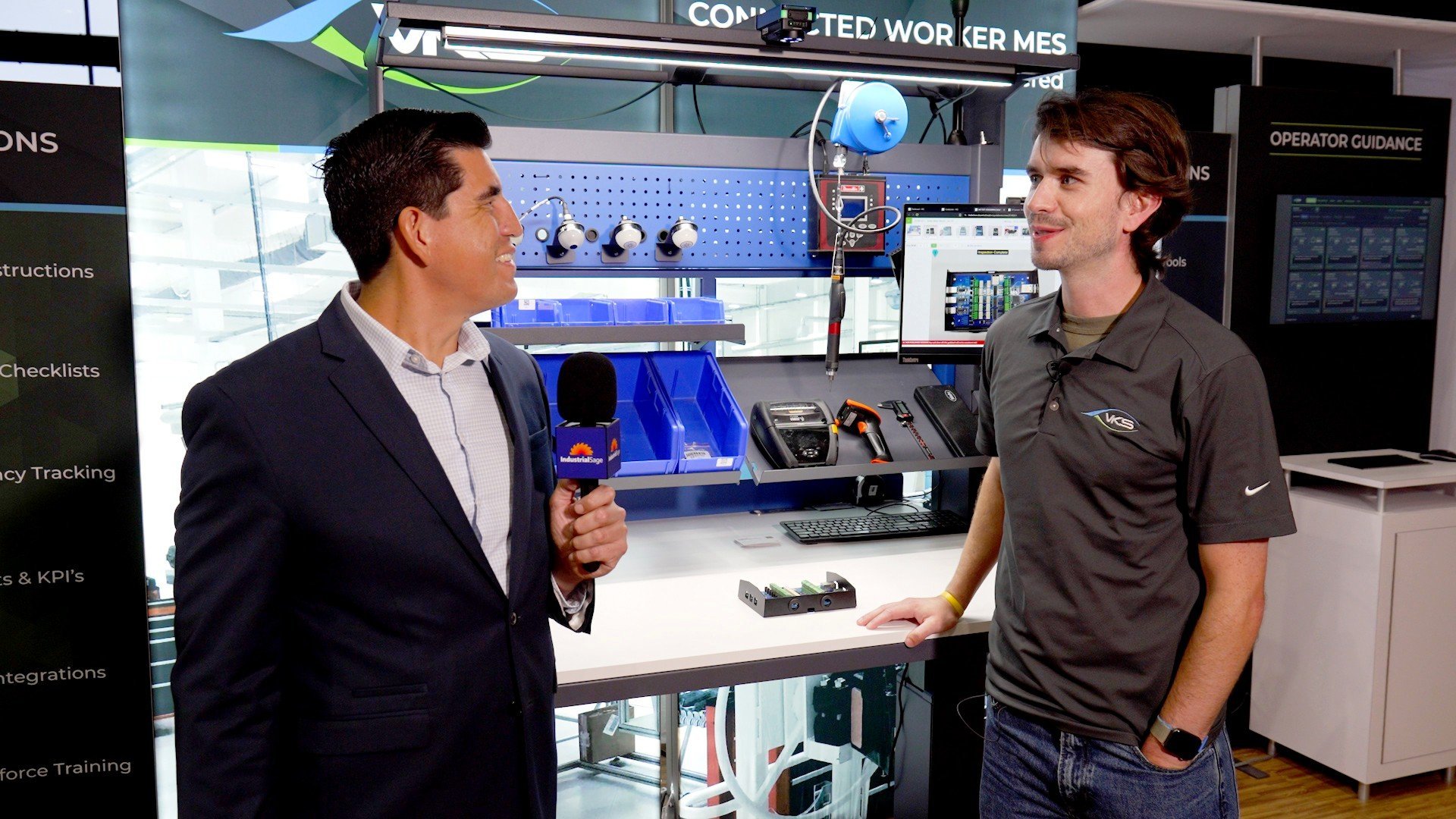
IndustrialSage sat down with Tim Woodford, Sales Engineer at VKS, on the show floor at IMTS 2026. Watch the full interview here.
Built by a Contract Manufacturer for Itself
Woodford describes the platform plainly.
“VKS, Visual Knowledge Share. So it’s a digital work instruction platform for connected workers. So it’s operator guidance, step-by-step, looking at pictures, watching videos, seeing how to do your job in a standard, repeatable way. We’re collecting data. We’re connecting with edge devices. We’re linking to ERPs.”
Then the detail worth more than the feature list.
“VKS is actually a spinoff company. So us, ourselves, we’ve been in business since 2011, so 15 years, but we were spun off from a contract manufacturer, and they’ve been around 60 or 70 years, I believe, and they built us for their own needs.”
Software built by a manufacturer to solve its own problem tends to differ from software built by a software company to address a market. The first kind is shaped by what actually goes wrong at a station. It usually looks less elegant in a demo and survives contact with a shop floor better, because every feature in it exists because somebody got burned by its absence.
A contract manufacturer is also the hardest possible first customer. High mix, constantly changing customer requirements, and other people’s quality standards to satisfy. A tool that works there has already met most of the conditions a typical plant will throw at it.
Walking a Job the Way an Operator Sees It
Rather than describe the product, Woodford runs one.
“This is what the operator would see when they’re going through the job. So first thing it’s asking us to do here is an inspection. So we want to know the serial number of the part we’re going to be assembling, and confirming that it’s defect-free. So I’ll just scan this barcode, scan that in, confirm we’re free of defects, and now I can start my job.”
Note the order. Identity first, condition second, work third. The part is tied to a serial number before anyone touches it, which is what makes everything recorded afterwards attach to a specific unit rather than to a shift or a batch.
“So we can work with torque tools, validate that our torque specs are being met. So we torque our bolts, pop, pop, pop, and validate that everything’s all set. And then we can also link with vision systems. So this will take an image of the assembly, validate it was done properly, and then move us on to the next step as well after that.”
Two different kinds of check are happening there, and the distinction matters. The torque tool confirms a process parameter at the moment of the operation. The vision system confirms the outcome after it. Together they cover the two ways an assembly step goes wrong: done to the wrong value, or not done at all.
The Instruction Is the Record
Here is why this matters more in defense and aerospace than anywhere else.
Traceability in that world is not a best practice, it is a contractual flowdown. Standards and prime contractor requirements expect records documenting each stage of the product lifecycle through manufacturing, assembly and testing, traceable back to original materials and lot numbers. The working test is whether a manufacturer can take one failed component and identify every product it went into and every customer who received it, years after it shipped. One prime’s fastener clause goes as far as requiring attestation that each lot carries complete traceability, and where the chain of custody is incomplete, a specific statement on the certificate of conformance covering the sampled verification records that do exist.
The gap most plants actually have is not a missing standard. It is a missing join. Torque data gets captured by the tool at the operation and then lives in the tool’s own log, never linked to the serialized build record for that unit. You can prove the department torqued things correctly in general. You cannot always prove what happened to unit 4,812.
Auditors are specifically looking for that join: objective evidence tying the written requirement to live production records, confirming that what is documented is what is being executed.
A system where the operator cannot advance until the scan, the torque validation and the vision check have all passed closes that gap by construction. The record is not a parallel activity performed by the quality department afterwards. It is the residue of having done the job. That is a meaningfully different proposition from a nicer-looking instruction, and it is the one that justifies the integration work.
It is the same pressure we found in standing up aerospace production from scratch, where the documentation burden arrives at the same moment the rate does.
Anybody Off the Street
On how long a new operator takes to become useful, Woodford sets the bar deliberately low.
“If you’ve used a computer before, you should be pretty comfortable with VKS. That’s one of the main foundations of VKS, I would say, would be we want to be able to take anybody off of the street or someone else from a different area of the shop floor, and be able to follow the instruction and build the part.”
The second half of that sentence is the one that pays. “Someone else from a different area of the shop floor” is not about hiring, it is about flexibility. A plant that can move a person from one cell to another without a training cycle has capacity it did not know it had, which matters more than usual when the people simply are not available to hire.
It is also the honest limit of the claim. Instructions good enough for a newcomer to follow do not make that person a machinist or a welder. What they do is let a defined, repeatable assembly task be performed correctly by whoever is standing there, and a surprising share of factory work is exactly that.
Armored Vehicles, Quickly
Asked what he is proudest of, Woodford picks an implementation rather than a feature.
“I did a demo and then made a sale with a customer in the defense industry. They were doing armored vehicles for the United States Army. So they got up to date really quickly. A quick implementation of VKS tied in with torque tools to validate everything was met. That was a very good implementation. It was good success on that one.”
Armored vehicle assembly is a fair stress test for the whole argument. The torque specifications are safety critical, the traceability requirements are contractual, and the production rate is set by something other than the manufacturer’s convenience. Being able to stand that up quickly is the claim, and the reason it is possible is that the validation is part of the instruction rather than a separate system bolted alongside it.
More from the show floor: the full From the Floor series from IMTS 2026.
About VKS
VKS, or Visual Knowledge Share, builds a digital work instruction and connected worker platform for manufacturers, covering step by step operator guidance, data collection, traceability, and integration with torque tools, vision systems and ERP. The company spun out of a long established contract manufacturer and has operated since 2011. Learn more at vksapp.com.
Frequently Asked Questions
What are digital work instructions?
Digital work instructions guide an operator through a job step by step on a screen, using pictures and video rather than paper documents. On a connected platform they also collect data as the work happens, integrating with devices such as torque tools, vision systems and ERP so the instruction and the production record are produced together.
How do digital work instructions support traceability?
By tying every captured value to a specific unit. The job starts by scanning the part’s serial number, so the torque readings, inspection confirmations and vision checks that follow attach to that unit rather than to a shift or a batch. The record is a byproduct of doing the work.
Why does torque data often fail to reach the build record?
Because the torque tool logs the value in its own system and nothing joins that log to the serialized build record for the unit. A plant can show it torques correctly in general but cannot always prove what happened on a specific serial number, which is the evidence an auditor looks for.
What traceability do aerospace and defense manufacturers need?
Records covering each stage of manufacturing, assembly and testing, traceable back to original materials and lot numbers, so a failed component can be traced to every product it went into and every customer who received it years after delivery. Prime contractor fastener clauses can require attestation of complete lot traceability.
How long does it take to train an operator on VKS?
Tim Woodford of VKS says that if you have used a computer you should be comfortable with it, and that a founding goal was letting someone from a different area of the shop floor follow an instruction and build the part. The practical benefit is moving people between cells without a training cycle.
What is VKS and where did it come from?
VKS stands for Visual Knowledge Share. It is a digital work instruction and connected worker platform that was spun out of a contract manufacturer with 60 to 70 years in business, which originally built the tool for its own production floor. VKS has operated as its own company since 2011.

Author: Wes Garrett
Content and Growth Marketing Producer | From Strategy to Execution, Delivering Impactful Media Solutions and Client Success


