

Key Takeaways
- Mainzinger on the timing of the demand shift: quoting activity ran extremely high for 18 months plus, and then “this spring the faucet finally opened.”
- The order data agrees. US manufacturing technology orders in the first half of 2026 totaled $3.44 billion, up 36 percent on the first half of 2025, the strongest half year since the survey began in 1998.
- The detail inside that record: the number of machines ordered was 2.6 percent lower than the prior half. The value grew on larger, more automated, more sophisticated machines rather than on unit volume.
- The MB-100V is a double column machining center with a three meter by one meter table, filling the gap between the existing MB-80V and Okuma’s very large machines.
- Okuma was founded in Nagoya in 1898 making noodle machines, moved into machine tools in 1904, and built its own control from 1963.
A double column machining center is not a machine anyone buys speculatively. It is a bridge-type structure built to hold accuracy across a large table, it occupies serious floor space, and it is specified when a shop knows it has large, heavy, precise work coming. Which makes the decision to extend a double column line a reasonable proxy for what a builder believes about demand.
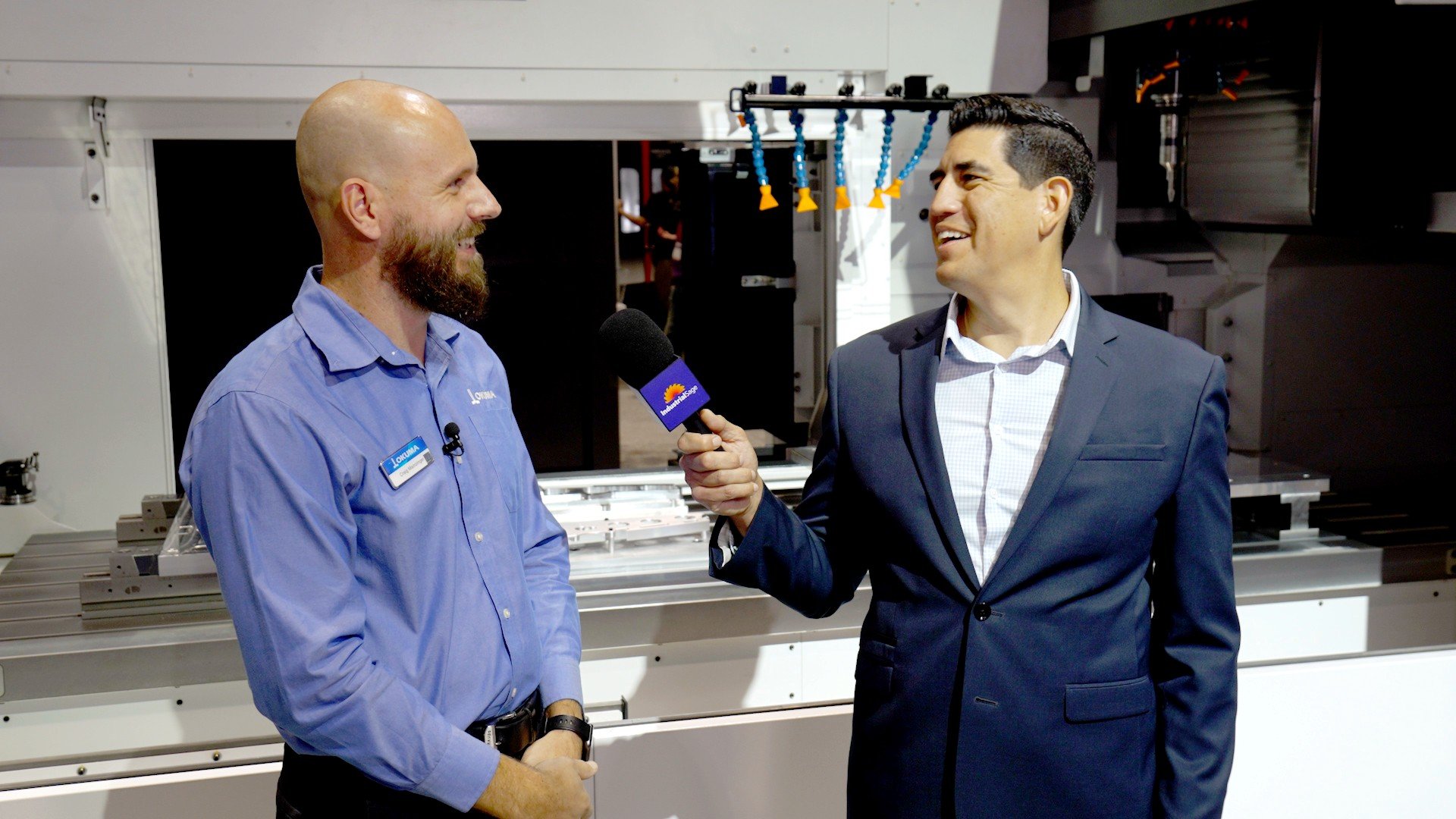
IndustrialSage sat down with Craig Mainzinger, Applications Engineering Manager at Okuma, on the show floor at IMTS 2026. Watch the full interview here.
It Started With Noodles
Mainzinger volunteers the company history before being asked, and it is better than most.
“We’re a Japanese-headquartered machine tool builder. Our company actually started, believe it or not, as a noodle-making company. So we made machines to make noodles. Then we needed better metalworking machines to make better noodle machines, and it’s just progressed.”
The record bears him out. Okuma was founded in Nagoya in 1898 building noodle machines, moved into machine tools around 1904, developed its own numerical control in 1963 and marked its 125th anniversary in 2023. The detail he draws out of it is the part that matters commercially.
“The whole reason our founder started making noodle machines was he didn’t like the noodle machines that were out there. So it’s always been legendary quality, legendary reliability.”
A company that builds its own controls is unusual, and it traces back to the same instinct: if the thing you depend on is not good enough, build it.
Filling the Gap in the Line
The machine behind them is an addition rather than a replacement.
“We can start with the machine behind us being our MB-100V. So we have an MB-80V that has been out for a while, and we have a line of double column machining centers. So these get up into the several tens of feet table size, and there was a gap there still. So now this machine is three meters by one meter table. So now that is starting to fill that gap.”
Read that as a statement about customers rather than about engineering. Okuma already served the very large end, where tables run to tens of feet, and the smaller end below the MB-80V. The gap being filled sits in between, which is where a shop lands when its parts have outgrown a standard vertical machining center but have not become structures.
That is precisely the size class that grows when aerospace structures, energy components and large fabricated assemblies pick up at once.
This Spring the Faucet Finally Opened
Every exhibitor was asked whether reshoring is genuine. Most answered directionally. Mainzinger gave a date.
“For the last 18 months plus, we’ve seen the quoting activity extremely high. But this spring the faucet finally opened and we have been busy.”
That sentence describes a specific and recognizable pattern: a long period in which customers are pricing projects without committing, followed by a sudden conversion to orders. Quoting activity is interest. Orders are conviction, and the gap between them is where uncertainty lives.
The national data tracks his account closely. US manufacturing technology orders hit $681.3 million in March 2026, up 31.5 percent year over year and 40.3 percent on February. April softened month to month at $593.6 million but still ran 33.2 percent above April 2025. May reached its highest value since November 2017, and June came in at $672.7 million, up 56.8 percent on June 2025. For the first half as a whole, orders totaled $3.44 billion, 36 percent above the first half of 2025 and the strongest half year recorded since the survey began in 1998.
So the faucet metaphor is accurate, and spring is the right season for it.
There is a wrinkle inside the record that deserves more attention than it has received. While the value of orders set a record, the number of machines ordered fell 2.6 percent against the preceding half. The industry association attributes much of the growth in value to additional automation attached to increasingly sophisticated machinery.
In other words, this is not primarily a story of more machines. It is a story of bigger and more automated ones. Which is a very good explanation for why a builder would spend its development budget extending a double column line and showing it at IMTS, and it matches what we heard across the floor about buyers standing up capacity for programs that do not exist yet.
Everything Is On Fire, In a Good Way
On where the demand concentrates, Mainzinger is specific about the sequence.
“When it first started coming up, data centers were kind of lead, data centers and defense were leading. And data centers still seems to be very hot.”
Then the line from a recent internal meeting that probably captures the mood of the whole show.
“One of the more recent sales meetings that I was in on, it was put a good way to say, everything is on fire right now.”
Data centers leading a machine tool cycle is worth sitting with, because data centers are not an obvious machining customer. What they consume is power infrastructure, cooling and structural steel, and all of that is made on machines. The buildout reaches the machine tool market indirectly, through everyone who supplies it, which is the same path we traced through the welding side of the same demand.
More Lab Technician Than Machinist
Asked what he is proudest of, Mainzinger picks a job that sounds routine and was not.
“Basically some fairly simple drive line parts on a vertical lathe, and we used a milling tool. We used a sensor with one of our partners and a milling tool to measure the vibration and then remove metal to balance the parts so they don’t vibrate anymore. And then those parts would go onto heavy equipment like trucks, dump trucks, things like that.”
Measuring imbalance and then cutting metal to correct it, on the same machine, is a closed loop between metrology and machining that most shops still run as two separate departments. His reflection on doing it is the human part.
“I felt more like a lab technician scientist than a machinist at that time. I mean, I was dealing with numbers and spreadsheets and looking at vibration and learning about stuff I’ve never heard of, terminology in the balancing world. I wasn’t familiar with any of that stuff.”
That is a fair description of where applications engineering has gone, and of what the job increasingly asks of the people doing it.
More from the show floor: the full From the Floor series from IMTS 2026.
About Okuma
Okuma is a Japanese machine tool builder founded in Nagoya in 1898, producing CNC lathes, machining centers, double column machining centers, grinders and its own OSP control. Learn more at okuma.com.
Frequently Asked Questions
What is a double column machining center?
A machining center built on a bridge-type structure with the spindle carried between two columns, which keeps the machine rigid and accurate across a large table. They are specified for large, heavy or precise workpieces and occupy substantial floor space, so they are bought against known work rather than speculatively.
What is the Okuma MB-100V?
A double column machining center with a three meter by one meter table, shown at IMTS 2026. It sits above the existing MB-80V and fills the gap between that machine and Okuma’s very large double column machines, whose tables run to several tens of feet.
Are US machine tool orders actually up in 2026?
Yes, substantially. First half 2026 manufacturing technology orders totaled $3.44 billion, up 36 percent over the first half of 2025 and the strongest half year since the survey began in 1998. March reached $681.3 million and June $672.7 million, up 56.8 percent year over year.
Is the 2026 order record about more machines or bigger ones?
Mostly bigger and more automated ones. Despite the record order value, the number of machines ordered was 2.6 percent lower than the preceding half, with the industry association attributing much of the value growth to additional automation on increasingly sophisticated machinery.
Which sectors are driving machine tool demand?
Craig Mainzinger of Okuma says data centers and defense led the recovery, with data centers still running hot. Data centers reach the machine tool market indirectly, through the power infrastructure, cooling equipment and structural steel their construction consumes.
Did Okuma really start by making noodle machines?
Yes. Okuma was founded in Nagoya in 1898 producing noodle-making machines, moved into machine tools around 1904, and developed its own numerical control in 1963. Mainzinger notes the founder started because he did not like the noodle machines available at the time.

Author: Wes Garrett
Content and Growth Marketing Producer | From Strategy to Execution, Delivering Impactful Media Solutions and Client Success


