

Key Takeaways
- The NIOSH lifting equation starts from a load constant of 51 pounds, and that figure applies only under ideal conditions: a two-handed, smooth lift directly in front of the body with a good grip.
- Every real-world factor, horizontal reach, start height, travel distance, twisting, frequency and grip quality, is a multiplier that only reduces that number. The bar stock in the Schmalz booth weighs about 80 pounds.
- Overexertion has long topped the list of disabling workplace injuries. A widely cited insurer index put overexertion involving outside sources at $15.08 billion a year, roughly 25 percent of total workplace injury cost.
- Welch’s business case in one line: the equipment is “cheap compared to a back injury or onboarding new people.”
- Schmalz builds across Germany, Sweden and North Carolina, and works with local machine shops in Charlotte, Virginia and Ohio depending on what makes sense to source where.
Ergonomic material handling is the rare factory investment that is not justified by throughput. Nobody buys a lift assist because it moves a part faster than a strong person can. They buy it because the strong person is forty-eight years old, there is no one behind him, and one bad lift takes him out for six months.
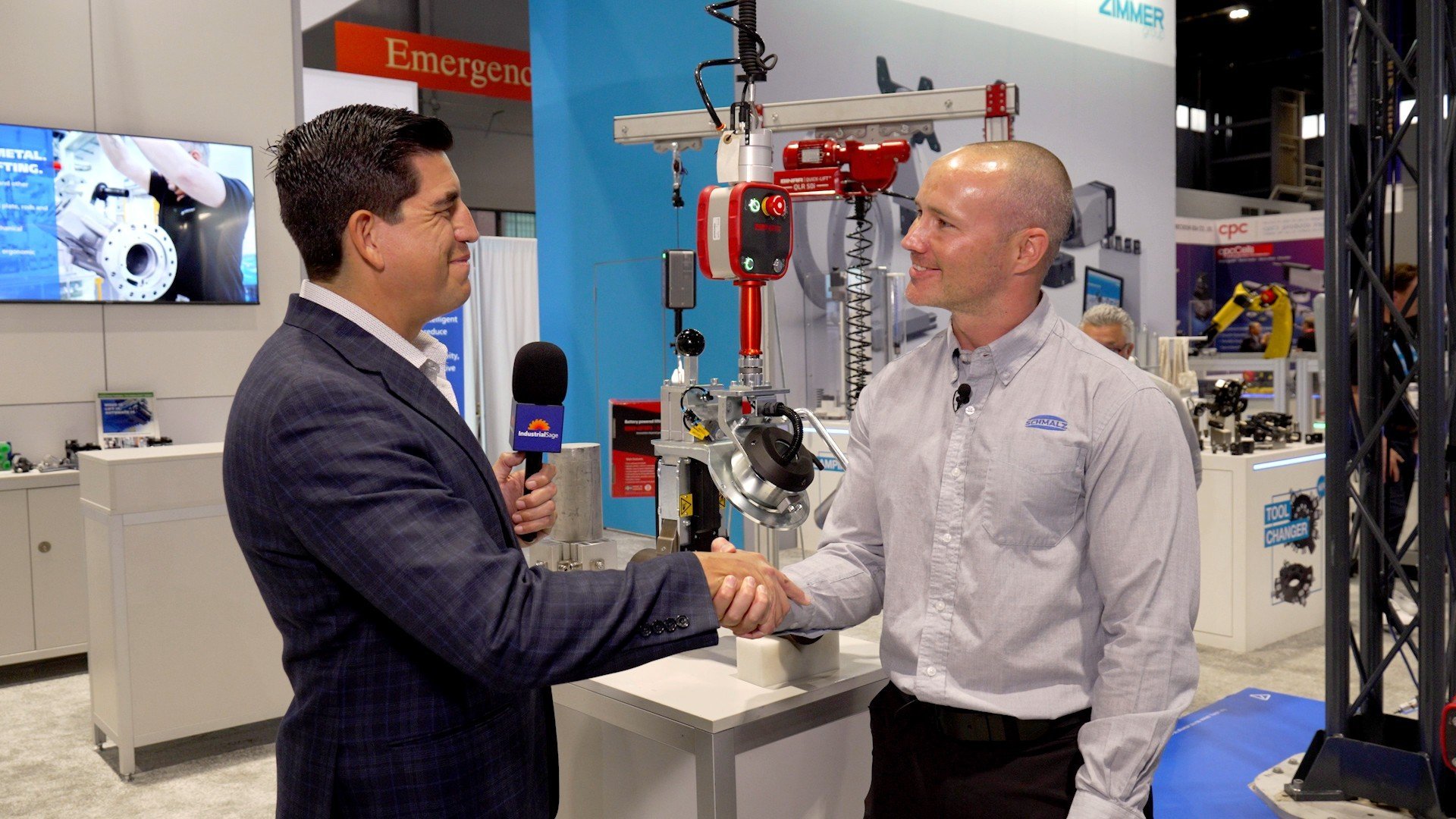
IndustrialSage sat down with Grant Welch, National Sales Manager at Schmalz, on the show floor at IMTS 2026. Watch the full interview here.
Eighty Pounds, Moved With Two Fingers
Schmalz covers more ground than most visitors expect. As Welch describes it, the company does “vacuum tooling, magnetic clamping, kind of whatever you need to pick up, we’ve probably got a solution for it,” spanning manual handling equipment and robotic end of arm tooling, out of a German parent with some thirty subsidiaries and a US base in Raleigh.
At IMTS the focus was the Binar Handling line, which Schmalz acquired in 2022 from Sweden and continues to run under its own name. The demonstration was deliberately unspectacular.
“This is as easy as it gets here. A really common application here at IMTS is handling this kind of bar stock. You’ve literally got a clamp that clamps onto the product. You pick it up, takes no force whatsoever. You’re literally just moving it up and down with your fingers. And then if you need to rotate that in the vertical, you spin it up like that.”
Then the detail that makes the point.
“I believe it’s about 80 pounds. Nobody’s been able to curl it with one hand.”
That line gets a laugh at a trade show. It is also the entire argument, and the published ergonomics data explains why.
Fifty-One Pounds Is Where the Math Starts
The reference point for manual lifting in the United States is the NIOSH lifting equation. Its load constant is 51 pounds, reduced from 90 pounds when the equation was revised in 1991, and it represents a weight considered acceptable under ideal conditions for most of the working population.
The word doing the work in that sentence is “ideal.” The constant assumes a two-handed lift, a smooth motion, the load directly in front of the body, a moderate width object and a good handhold. The actual recommended weight limit for any specific job is that 51 pounds multiplied by six factors covering how far out the load is held, how high it starts, how far it travels, how much the body twists, how often the lift repeats and how well the object can be gripped.
Every one of those multipliers is a fraction. They can only bring the number down.
So consider the lift Welch is describing. Bar stock is long, which pushes the center of mass away from the body and shrinks the horizontal multiplier hard. It gets loaded into a machine, so it starts low or ends high and usually involves a turn. It happens many times a shift. Under those conditions the defensible limit is not 51 pounds. It is some meaningful fraction of it, and the part weighs 80.
A common shorthand holds that nobody should ever lift more than 51 pounds. That is a simplification of what the equation says, and the more accurate reading is less comforting rather than more: 51 pounds is the best case before reality is applied.
Cheap Compared to a Back Injury
Asked what his customers are wrestling with, Welch does not talk about cycle time.
“It’s all about ergonomic issues. People don’t have the people to lift this stuff, to load these machines. It’s dangerous. They’ve got a lot of injuries and stuff that they’re dealing with. They’ve got a lot of turnover in their workforce. So this is things that we can use to help them load and unload machines without having to put any kind of strain whatsoever on the operator.”
And then the sentence that should probably be on the quote sheet.
“A lot of this equipment seems really cheap compared to a back injury or onboarding new people.”
The cost side of that comparison is well documented, if imperfectly. Overexertion has consistently ranked at or near the top of the causes of disabling workplace injury in the United States, and a widely cited insurer index put overexertion involving outside sources at roughly $15.08 billion a year, close to a quarter of the total cost of serious workplace injuries. Back cases specifically account for something on the order of a fifth of workplace injuries and illnesses, most of them tied to lifting.
Those are national aggregates and a shop owner does not feel them as such. What a shop feels is one claim, one experience modifier, one person who does not come back, and a job that still has to be covered. Against that, the capital cost of a lift assist is a rounding error, which is exactly Welch’s point.
The People Who Are Not Coming Back
The second half of his answer is the part that has changed most in the last few years.
“And then you’ve got an aging workforce in some of this stuff, where lifting 80 pounds or large sheets of steel or whatever isn’t really an option for everybody.”
This reframes ergonomic material handling from a safety purchase into a hiring one. A job that requires repeatedly moving 80 pounds has quietly restricted its own candidate pool to people who can repeatedly move 80 pounds, in a labor market where shops cannot fill the roles they already have. Removing the lift widens the pool, and it keeps the experienced people who can still do the thinking but should not still be doing the lifting.
That is the same calculation playing out across the floor at IMTS, whether the constraint is a trade nobody is entering or knowledge that leaves with the person who holds it. The equipment is not replacing labor that exists. It is accommodating labor that has to last longer.
Built Where It Makes Sense
Asked whether the tooling is made in house, Welch gives an unusually candid answer about a distributed supply chain.
“Some of it comes out of Germany, some of it comes out of Sweden, some of it gets manufactured in North Carolina. If it makes sense to bring it from overseas, we do. If it makes sense to make it locally, we do. We do a little bit in-house in our North Carolina facility, and then we work with local partners, machine shops in Charlotte, Virginia, Ohio, for whatever the need is.”
The Sweden reference is the Binar operation. The Charlotte, Virginia and Ohio machine shops are the part worth noticing, because this is what the reshoring conversation looks like from the inside of an actual supply chain: not a wholesale relocation, but a running judgment about which parts are worth making close to the customer.
On what he is proudest of, Welch picks an electric vehicle manufacturer that brought a car into the Schmalz facility as test material.
“They had some really challenging applications for us. They brought in one of their EV cars into our facility as test material, and then we prototyped, figured out some tools, shot a variety of different test videos and ended up supplying 30, 40 different lifters and grippers and end of arm tools. It’s cool seeing them out on the road and being like, oh yeah, we did that windshield or that hood.”
Thirty to forty distinct tools for one vehicle program is a useful sense of scale for how specific this work gets. Every panel is its own geometry, its own weight and its own grip problem.
More from the show floor: the full From the Floor series from IMTS 2026.
About Schmalz
Schmalz is a German manufacturer of vacuum lifting and handling technology, vacuum gripping systems, magnetic clamping and robotic end of arm tooling, with US headquarters in Raleigh, North Carolina. Its Binar Handling line, acquired in 2022, produces ergonomic lifting equipment in Trollhattan, Sweden. Learn more at schmalz.com.
Frequently Asked Questions
What is the NIOSH recommended weight limit for lifting?
The NIOSH lifting equation uses a load constant of 51 pounds, set when the equation was revised in 1991. That figure applies only under ideal conditions: a two-handed, smooth lift directly in front of the body with a good grip. The limit for a specific job is that constant multiplied by six reducing factors.
Is 51 pounds a hard lifting limit?
No, and the common shorthand that nobody should lift more than 51 pounds misreads the equation. The 51 pound load constant is the best case before adjustment. Reach distance, start height, travel, twisting, lift frequency and grip quality all reduce it, so most real jobs have a recommended limit well below 51 pounds.
What does overexertion cost employers?
Overexertion consistently ranks at or near the top of causes of disabling workplace injury in the United States. A widely cited insurer index put overexertion involving outside sources at about $15.08 billion a year, roughly a quarter of the total cost of serious workplace injuries, with back cases making up around a fifth of injuries overall.
What is a lift assist and how does it differ from a hoist?
A lift assist supports the weight of a load while the operator still guides it by hand, so the motion stays fast and intuitive rather than being driven by controls. Grant Welch of Schmalz demonstrates a clamp holding roughly 80 pounds of bar stock that an operator raises, lowers and rotates with their fingers.
Why are manufacturers buying ergonomic handling equipment now?
Because the constraint is people rather than throughput. Welch cites injuries, workforce turnover and an aging workforce for whom lifting 80 pounds or large sheets of steel is not realistic. Removing the lift widens the pool of people who can do the job and keeps experienced staff in it longer.
What is Binar Handling?
Binar Handling is a Swedish manufacturer of ergonomic lifting and handling equipment, based in Trollhattan and founded in 1979. Schmalz acquired it in 2022 and continues to run it under the Binar Handling name, where it complements Schmalz’s manual handling range.

Author: Wes Garrett
Content and Growth Marketing Producer | From Strategy to Execution, Delivering Impactful Media Solutions and Client Success


