

Key Takeaways
- Cushman & Wakefield’s 2026 cost guide puts small industrial construction at about $144 per square foot, up 3.6 percent year over year, with medium projects near $87 and large near $78.
- The input costs behind that: copper up 39 percent, steel up 17 percent year over year, and US construction wages up 4.3 percent.
- A Modula MA unit occupies under 100 square feet of floor while holding roughly 1,000 square feet of parts and inventory.
- Published research puts about half of order picking time into travel, and order picking at roughly 50 percent of all warehouse labor. Lind says two or three units let one operator do the work of about four people.
- Training takes an hour, two at most, and Lind has yet to meet a 3PL whose payback ran longer than 18 months, with the usual range 12 to 18.
Factory floor space optimization used to be a European preoccupation, the sort of thing you worried about if your plant was wedged into a town that predated it. Ask an American manufacturer running short of room and the answer was to put up a building. That answer has quietly stopped being available, and the reasons are worth laying out because they are not only about construction prices.
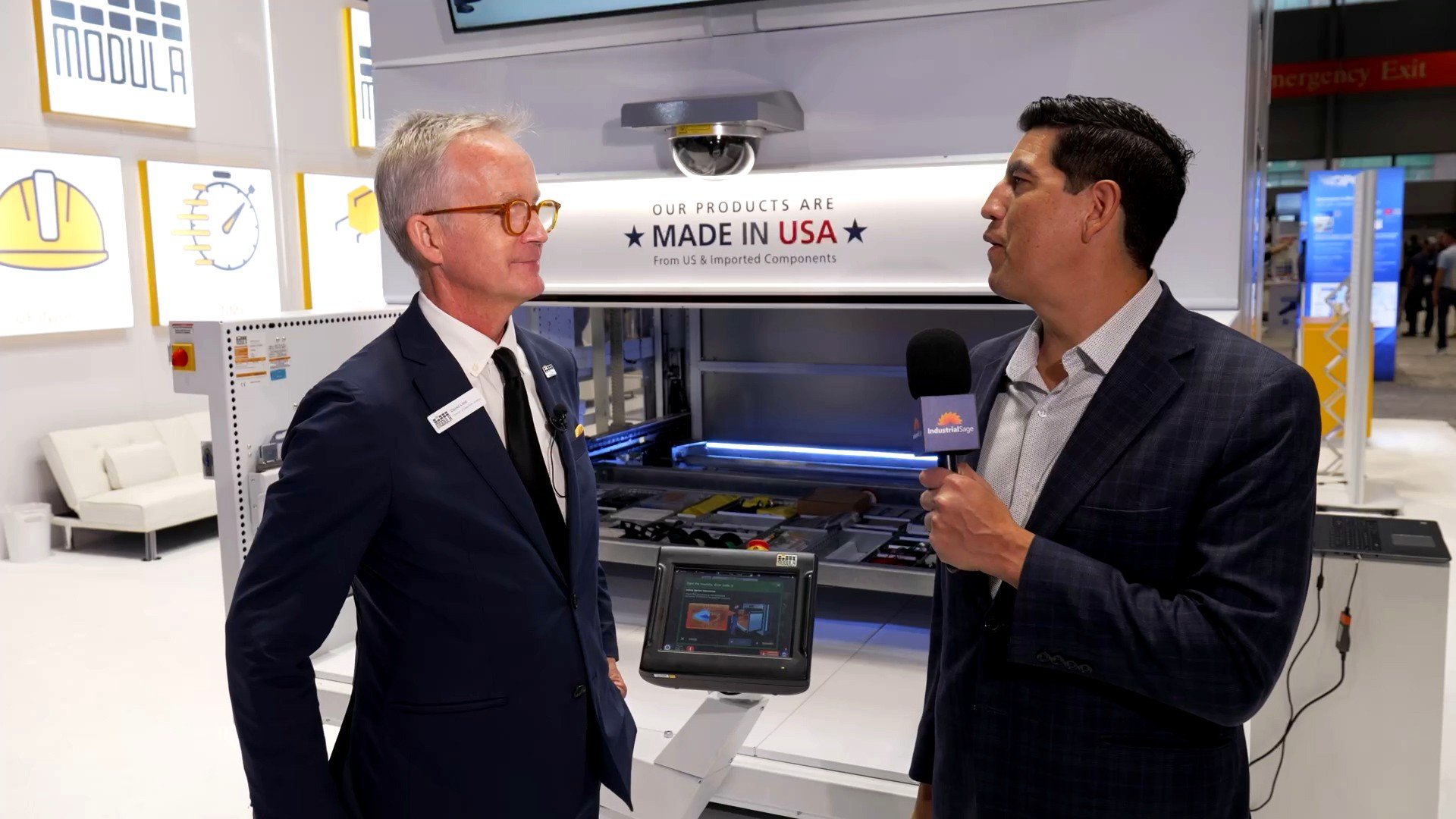
IndustrialSage sat down with David Lind, Director of Sales at Modula, on the show floor at IMTS 2026. Watch the full interview here.
The Sentence Customers Stopped Saying
Modula has been building vertical lift modules for about 40 years, and builds its North American units at a plant in Franklin, Ohio. Lind moved to the US five years ago, and the shift he describes is in what customers volunteer.
“Throughout Europe, space is a premium. I came here five years ago from Italy, and a lot of manufacturers were saying, well, I just have to build on some extra space to my building. Nobody’s saying that anymore. Everyone is saying, I’m out of space. I don’t want to build anymore. It’s too expensive, and I can’t find any people to work in the space anyway.”
Three objections, and only the middle one is about money. Take them in order.
On cost, Cushman & Wakefield’s 2026 industrial construction guide puts small industrial projects at roughly $144 per square foot, rising 3.6 percent year over year, with medium projects near $87 and large ones near $78. The spread is the important part: the smaller your expansion, the worse your cost per square foot, which punishes exactly the incremental bay-or-two addition a growing shop wants. Behind those figures sit copper up 39 percent, steel up 17 percent and construction wages up 4.3 percent year over year, so the direction is not obviously reversing.
On the third objection, Lind is making a point most capacity conversations skip. Floor space is not a standalone asset. It is a thing you have to staff. Adding 5,000 square feet of racking to a plant that cannot fill its current shifts does not add capacity, it adds walking.
Under 100 Square Feet, Holding a Thousand
The density argument is simple enough to check with your eyes, which is why it demos well on a trade show floor.
“Look at the footprint behind you. You’re looking at less than 100 square foot of footprint carrying potentially 1,000 square foot of parts and inventory.”
What a vertical lift module does is trade floor area for height, which is the one dimension almost every industrial building already has and almost no shelving system uses. Parts live in trays stacked in a column, and the machine brings the requested tray to an opening at waist height.
Run the arithmetic against construction. Recovering 900 square feet of equivalent storage by building it, at small-project rates, is a six-figure proposition before you have hired anyone to work in it. That is the comparison Lind’s customers are implicitly making, and it explains why the objection has shifted from whether to automate storage to how many units to start with.
One Operator Doing Four People’s Work
The labor claim is the bigger one, and it rests on a well-documented inefficiency.
“Picture two or three of these side by side, and you’ve got one operator doing the work of potentially four people. So first of all, you need less people to do it.”
The research behind why that is possible is unambiguous about where picking time goes. Studies of order picking have found that roughly half of total picking time is travel, simply moving between locations, and that order picking accounts for something near 50 percent of all warehouse labor activity, with higher figures in very narrow aisle layouts.
A vertical lift module inverts the relationship. Instead of sending a person to the part, it sends the part to the person, which deletes the travel component rather than optimizing it. That is the structural reason one operator at a bank of machines can replace several walking a floor, and it is a different kind of saving from picking faster.
Lind then makes an argument about the job itself that is easy to dismiss and probably should not be.
“If you think about the jobs that people want to do, how much more attractive it is to work on a machine that’s innovative, that’s automated as your job, rather than being the one that walks through the warehouse picking off a trolley. There’s more training. You’re becoming a more specialized member of the workforce. You’re working automation.”
In a labor market where shops cannot fill roles, what the role feels like is a retention variable, not a soft one. It is the same logic as removing the lift from a job so more people can still do it at 55, and the same pressure behind trades nobody is entering.
An Hour to Train, and Then They Buy More
Adoption cost is where storage automation usually falls down, and Lind’s number is aggressive.
“If I was to hire you to work in my warehouse tomorrow, my factory, I could train you to use this in an hour. Maximum two hours, so no adoption time.”
The purchasing pattern that follows is the tell.
“You’ll often see a factory adopting one in a certain area for parts or tooling, then suddenly they get half a dozen more around the place. It’s very, very common to see a customer buy one within three years, have 10, 12, 14 machines throughout their distribution and factory.”
One to a dozen in three years is land and expand, and it only happens if the first unit pays. On that, the cleanest evidence Lind offers comes from the most unsentimental buyers he has.
“We have some customers that are 3PLs. They make money by being highly efficient and having no wastage. So for them, they buy a machine and it has to comply with a very strict ROI. And I have yet to come across a 3PL who’s told me that the ROI is any more than 18 months. It’s usually between 12 and 18 months.”
Third party logistics providers are a useful proxy because storage efficiency is not a cost center for them, it is the product. If the payback did not clear their hurdle, they would not be repeat buyers.
Strawberries in Singapore
Asked what he is proudest of, Lind goes somewhere unexpected.
“One of the coolest we’re working on is we grow fruit and vegetation in VLMs. So put your tray carrying tools and fastenings, we can also put in there bags of soil and put plants in them. So strawberries in Singapore, for example, where real estate value is massive. They go in, they get special lighting, special humidification, come down, and you can serve a market with a vertical lift selling and making strawberries inside it.”
It is a novelty answer that happens to restate the thesis exactly. The machine is not really a storage product. It is a way of buying height where ground is expensive, and Singapore is just the most extreme version of the trade every manufacturer in the booth was already making.
More from the show floor: the full From the Floor series from IMTS 2026.
About Modula
Modula manufactures vertical lift modules and automated storage systems for factories, warehouses and distribution centers, and has been building them for about 40 years. Its North American units are built at the company’s plant in Franklin, Ohio, serving manufacturing and 3PL customers. Learn more at modula.us.
Frequently Asked Questions
What is a vertical lift module?
A vertical lift module is an enclosed automated storage unit that holds parts in trays stacked in a column and delivers the requested tray to an opening at waist height. It trades floor area for building height, so a unit under 100 square feet of footprint can hold roughly 1,000 square feet worth of parts.
What does industrial construction cost per square foot?
Cushman and Wakefield’s 2026 guide puts small industrial projects around $144 per square foot, up 3.6 percent year over year, with medium projects near $87 and large near $78. Smaller expansions carry the worst cost per square foot, which is what makes an incremental building addition expensive.
How much warehouse labor goes to walking?
Published order picking research finds roughly half of total picking time is spent travelling between locations, and that order picking makes up close to 50 percent of all warehouse labor activity. Goods to person systems remove that travel rather than optimizing it.
What is the typical ROI on a vertical lift module?
David Lind of Modula says he has not encountered a third party logistics customer whose payback exceeded 18 months, with the usual range 12 to 18 months. He points to 3PLs specifically because storage efficiency is their product rather than an overhead line.
How long does it take to train an operator?
About an hour, and two at most according to Lind, which is why he describes the systems as having effectively no adoption time. The machine handles retrieval, so the operator is working at a fixed station rather than learning a warehouse layout.
Why are manufacturers choosing automated storage over expansion?
Three reasons given by customers: they are out of space, building is too expensive, and they could not staff the additional space if they built it. The third is the one most capacity planning overlooks, since floor space has to be staffed before it produces anything.

Author: Wes Garrett
Content and Growth Marketing Producer | From Strategy to Execution, Delivering Impactful Media Solutions and Client Success


