

Key Takeaways
- Boom Supersonic is building its own jet engines rather than buying them, targeting 25 engines a year starting in 2028.
- The production facility runs about 150,000 square feet and will hold roughly 80 machines. About 25 have arrived.
- Hepler has thrown out the industry’s three to five year engine design cycle in favor of build, test, build, test, supported by metal additive, rapid prototyping and AI in CNC programming.
- Propulsion is the component aerospace cannot source on a predictable schedule, which is why Boom is absorbing an engine line rather than buying engines.
- When XB-1 flew supersonic at Mach 1.18, the sonic boom never reached the ground. It reflected off the lower atmosphere and the microphone array recorded nothing.
The jet engine manufacturing bottleneck is the reason a supersonic airliner company is standing up a machine shop. Boom Supersonic could have bought propulsion from an established engine maker. Instead it is building an engine line from scratch, in America, and the logic behind that decision says more about the aerospace supply chain than it does about supersonic flight.
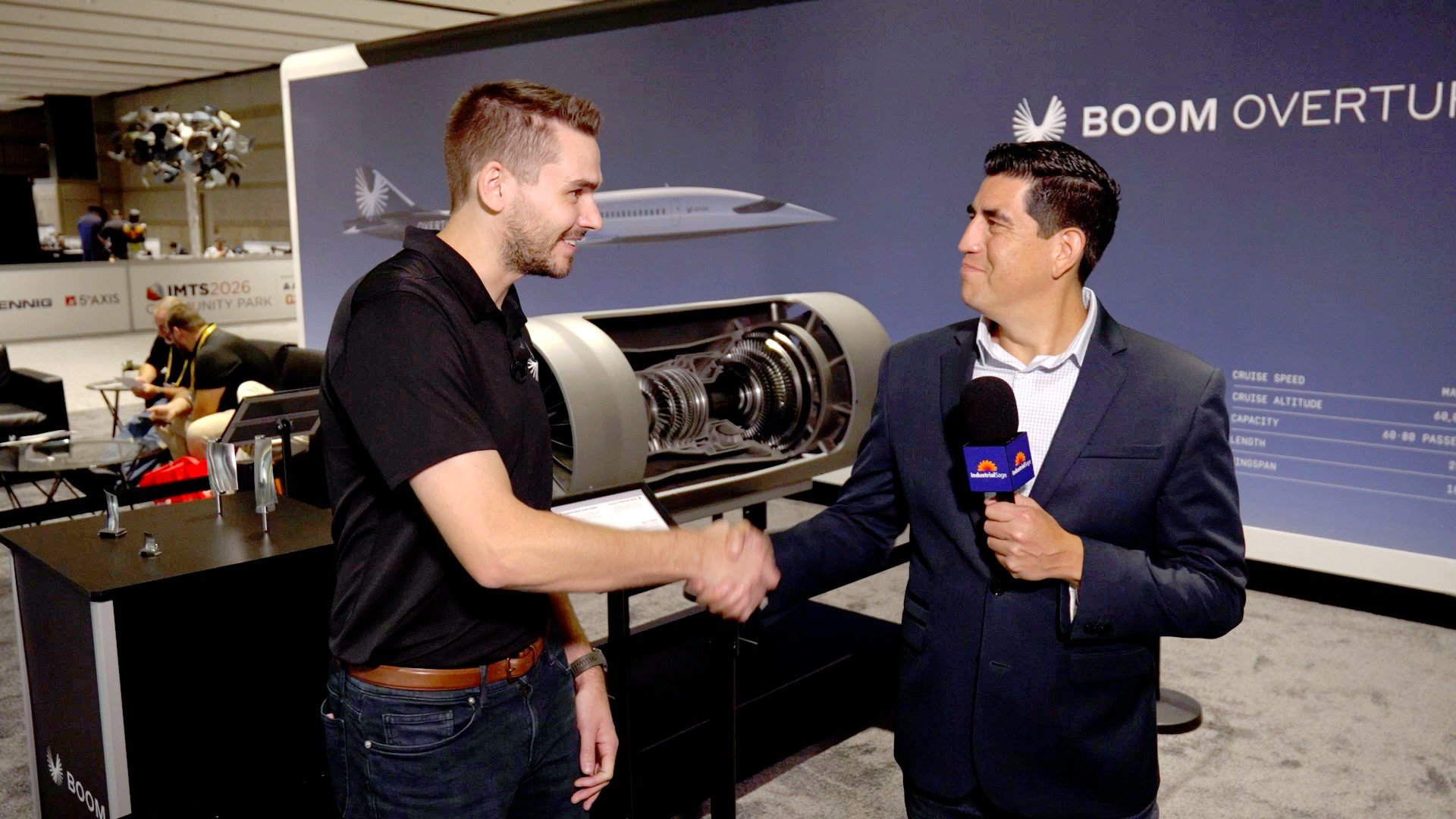
IndustrialSage sat down with Nate Hepler, Head of Manufacturing at Boom Supersonic, on the show floor at IMTS 2026. Watch the full interview here.
What Boom Is Actually Building
The company’s goal is Overture, a commercial supersonic airliner designed for Mach 1.7 at 60,000 feet. No airline has offered supersonic service since Concorde retired in 2003.
“Right now that’s targeted for overseas flight, but we are working towards a boomless cruise, which would allow us to fly supersonic over land, which even the Concorde wasn’t able to do.”
Underneath the airliner sits a manufacturing program most coverage skips. Superpower is Boom’s industrial gas turbine line. What the team learns there feeds Symphony, the engine that will actually power Overture.
“We’re bringing that capability in-house so we can advance our design, analysis, fabrication, build and test capability. All those things we’ll learn on Superpower we’ll apply towards Symphony.”
Then the number that matters.
“From there we’re standing up vertically integrated manufacturing capability to be able to make 25 of those engines a year starting in 2028.”
Why In-House, and Why Now
Building an engine line is an enormous undertaking for a company that has not yet delivered an airliner. The reason is that propulsion has become the hardest thing in aerospace to buy on a schedule you control.
Engine makers are capacity-constrained and their order books are long. For an established airframer that is a planning problem. For a company trying to iterate toward a new engine, it is fatal, because every design change has to queue behind someone else’s production. Buying propulsion means accepting someone else’s calendar, and Boom’s calendar is the product.
So jet engine manufacturing has stopped being something an airframer outsources and started being something it has to own. It is the most expensive response available and increasingly the only one that holds a timeline together.
This is the same pattern we have tracked across the industrial economy, where the binding constraint is never the obvious one. We have reported on gas turbine manufacturing capacity with order books running toward 2030, on power transformer lead times at 128 weeks, and on a welder shortage that compounds through retirement. In each case the companies that could not wait stopped waiting.
Build, Test, Build, Test
Owning the line only pays off if it moves faster than the alternative. Hepler is explicit that the traditional engine development model is the thing being discarded.
“We’re not going through the typical design process where it’s three to five years to design an engine and then we test it and see if it works. It is build, test, build, test, build, test.”
In jet engine manufacturing that is a strategy decision before it is an engineering one. A three to five year cycle assumes fabrication is slow and expensive, so you simulate exhaustively and commit once. Compressing it assumes the opposite: that you can make a part quickly enough to learn from the real thing.
“Whatever technologies, whatever capabilities we can do to iterate as quickly as possible, we will take advantage of those. So rapid prototyping, additive 3D printing with metallic, as well as how do we incorporate AI into this. AI from a CNC programming perspective, from a software perspective, from a design for manufacturing perspective.”
Worth noting where he puts AI. Not in the product. In CNC programming and design for manufacturing, the unglamorous middle of the process where an engine program actually loses months.
Ground Zero for a New Engine Line
Asked what he is excited about, Hepler describes a building that is still filling up.
“We are really at ground zero right now. We are standing up our production facility. That is about 150,000 square feet, and we’ll have about 80 different machines in there. So we’re about 25 have arrived.”
Roughly 55 machines still to land, against a 2028 production target. Jet engine manufacturing at that scale is as much a plant build as it is an engineering project. For anyone who has stood up a plant, that is the honest part of the interview: the capability exists on paper and in purchase orders, and the work now is processes, tooling, work holding and fixturing.
The Sonic Boom That Never Arrived
The flight test that earned Boom its credibility is also a measurement story. XB-1, the company’s demonstrator, went supersonic in early 2025.
“We used Schlieren photography, and we also partnered with NASA. So we had to time it just right so that the cameras on the ground were taking an image of XB-1 as it was passing past the sun. We also had a microphone array on the ground that was listening for that sonic boom, but the sonic boom never actually came.”
The aircraft was flown in what Hepler calls the Mach cutoff regime, at about Mach 1.18, where the boom refracts off the lower atmosphere and bends back upward instead of reaching the ground. That is the physics behind boomless cruise, and it is the difference between an airliner restricted to ocean crossings and one that can fly over land.
Hepler counts XB-1 as the work he is proudest of, and makes a claim about it worth repeating in full.
“We became the first company to design, build, test an independently developed civil supersonic aircraft and break the sound barrier. Never had been done before. Every other supersonic aircraft was backed by the government.”
The Part He Did Not Have to Say
Asked what he loves about the job after seven years, Hepler does not name the hardware.
“The reason I love this company is because of the extremely talented individuals that we have been able to grow and hire. Every day I’m becoming smarter by these people, whether it’s manufacturing engineers, technicians, machinists, designers.”
And his advice to anyone who thinks manufacturing is dull is the shortest answer in the interview.
“Get your hands dirty. Take things apart, put them back together. Take that remote apart even if your parents are yelling at you. Figure out how that machine works. Take the engine out of your car. Just be curious.”
More from the show floor: the full From the Floor series from IMTS 2026.
About Boom Supersonic
Boom Supersonic is developing Overture, a commercial supersonic airliner designed to cruise at Mach 1.7, along with Symphony, the engine intended to power it. Its XB-1 demonstrator flew supersonic in early 2025. Learn more at boomsupersonic.com.
Frequently Asked Questions
Why is Boom Supersonic building its own jet engines?
Propulsion has become the hardest component in aerospace to source on a predictable schedule. Rather than depend on an outside engine maker, Boom is standing up vertically integrated manufacturing targeting 25 engines a year from 2028, so that engine development pace is under its own control.
What is the difference between Superpower and Symphony?
Superpower is Boom’s industrial gas turbine line, used to build in-house capability across design, analysis, fabrication, build and test. Symphony is the engine that will power the Overture airliner. Lessons from Superpower feed directly into Symphony.
How big is Boom’s engine production facility?
Nate Hepler, Head of Manufacturing, describes a facility of roughly 150,000 square feet that will hold about 80 machines. Around 25 had arrived at the time of IMTS 2026, with process, tooling, work holding and fixturing still being established.
How is Boom compressing the engine design cycle?
The company replaced the conventional three to five year design-then-test cycle with repeated build and test loops. That is enabled by rapid prototyping, metal additive manufacturing, and AI applied to CNC programming and design for manufacturing rather than to the product itself.
Why is propulsion the hardest part of an aircraft to source?
Engine manufacturing is capacity-constrained with long order books, so a buyer inherits the supplier’s schedule. For a company iterating on a new design, every change queues behind someone else’s production. That is why Boom chose to build the capability in-house rather than purchase engines.
Why did XB-1’s sonic boom never reach the ground?
XB-1 flew in the Mach cutoff regime at roughly Mach 1.18, where the shockwave refracts off the lower atmosphere and bends upward rather than reaching the surface. A ground microphone array recorded no boom. That effect underpins the boomless cruise Boom wants for overland supersonic flight.

Author: Wes Garrett
Content and Growth Marketing Producer | From Strategy to Execution, Delivering Impactful Media Solutions and Client Success


