

Key Takeaways
- Job shops that historically did turning and chip making only are being asked by their own customers to add joining, which is pulling welding automation into shops that never had a robot.
- The sharpest demand spike Kawasaki saw after the tariff announcements came from raw material manufacturers, the companies that take raw bar and form it.
- veloWELD launched in the US in September 2024, built with a Kawasaki partner in Poland that has done welding since its founding.
- A two-axis positioner removes the part of the job that wastes a skilled welder’s time: stopping, repositioning the part for gravity, and re-gowning before every pass.
- Alexandre Boffi’s read on robotics: machines are not getting smarter. They are getting better at accepting intelligence from outside systems in real time.
Job shop welding automation used to be a question of volume. If you ran the same part thousands of times, a robot made sense, and if you did not, it did not. That calculation is breaking down, and the reason has less to do with robots than with what job shops are now being asked to make.
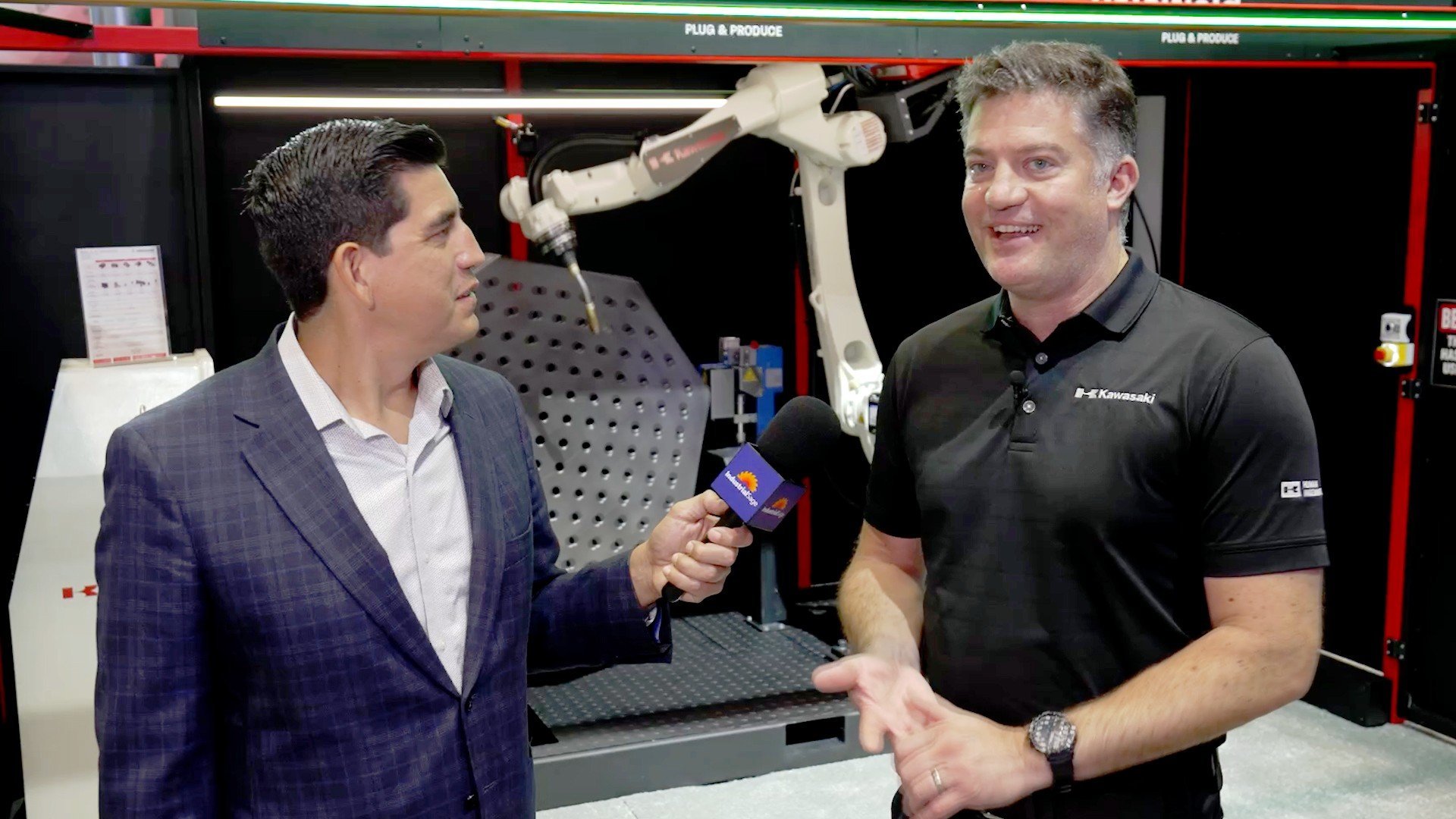
IndustrialSage sat down with Alexandre Boffi, Manager of General Industries Sales at Kawasaki Robotics, on the show floor at IMTS 2026, in front of a running veloWELD cell. Watch the full interview here.
The Shops Being Asked to Weld
Ask Boffi what has changed on the floor and he does not start with technology. He starts with the order book.
“A lot of, you know, smaller organizations, ones that traditionally maybe they only did turning and chip making, and now their customers are asking them for downstream processes where they’re doing joining and things like that.”
That is a quiet but consequential shift. A shop that has spent twenty years turning parts has no welding department, no weld engineer and no welders to retain. When a customer asks it to deliver a joined assembly instead of a machined component, the shop has three options: decline the work, hire into the tightest skilled trade in the country, or automate.
The first costs the account. The second is the problem Boffi hears about constantly.
“It’s hard to retain the welding talent, right? We hear that a lot.”
We have covered the arithmetic behind that elsewhere. The average American welder is in his late 50s, which means the shortage deepens through retirement no matter how hiring goes, a point we have heard from other corners of the same market.
What the Tariffs Did to the Order Book
The most specific thing Boffi said had nothing to do with robots. Asked where growth is coming from, he pointed at a demand signal most coverage missed.
“I think the sharpest spike that we saw after the announcements of the tariffs were companies that deal in raw material, because that was an immediate impact. Like if you’re getting the stuff from China, you’re getting it from India, you have to start sourcing it here because it’s cost prohibitive to do it elsewhere.”
He is describing a second-order effect. Tariffs do not create demand for robots. They make offshore raw material uneconomic, which moves forming work onshore, which lands on domestic shops that then need capacity they do not have.
“So the companies that deal with taking this raw bar, forming it into something, and then that goes into something else, their business jumped up almost immediately.”
A robotics vendor’s order book is an unusually honest place to read reshoring, because nobody buys a welding cell to make a political point. That demand signal lines up with what we have tracked across the US Manufacturing Investment Tracker.
Where the Growth Actually Is
Boffi named the verticals without hedging: defense spending, food and beverage, government contracts, and semiconductors. Kawasaki works with Oshkosh on the USPS postal truck program, and supplies a significant amount of the robotics used in semiconductor manufacturing.
Data center construction comes up too, though not the way most vendors tell it.
“We hear a lot right now, the data centers, you know, all the news about data centers, it’s huge, but a lot of those components are getting welded at smaller job shops.”
The hyperscaler buildout is not a hyperscaler manufacturing story. The enclosures, skids and structural components land in exactly the shops described above, the ones with more variability, more batch processing and no welding department.
Why Turnkey, and What the Positioner Actually Fixes
veloWELD is Kawasaki’s answer to a buyer who has never integrated a robot. It ships as a package: positioners, robot, weld supply, tracks, everything needed to get welding. It came out of a Kawasaki partner in Poland that has done welding since its founding, and reached the US market in September 2024.
The piece worth understanding is the two-axis positioner, because it targets the least visible cost in manual welding.
“Imagine a skilled welder having to stop every time, get the part in a position where the gravity feed is more conducive to what they’re trying to do, then go back, get your weld garb back on, continue welding. It’s just not very efficient.”
That is not welding time. It is handling time, and it consumes a scarce person doing work that requires none of their skill. Boffi’s framing of the division is blunt.
“You’ve got to use the dexterity and intelligence of the people that you do have on your floor, and then let the robots do the dumb movements that are repeatable.”
Robots Are Not Getting Smarter
Asked what has changed most in his career, Boffi went to programming, and made a distinction that cuts against most of the marketing in the category.
“When I came into the industry a long time ago, it was all about teach pendant programming, code-based programming, and that is just simply not going to be the way things are done in the near future.”
What replaces it is not an autonomous robot. It is a robot that takes direction from something else while it is moving.
“What we’re seeing in the industry is a dramatic and quick shift to not the robots gaining the intelligence, but being able to accept the intelligence from outside systems.”
Kawasaki calls this real-time control: external inputs dictating path and motion as the robot runs. Boffi is candid that it sounds rudimentary and is not.
For a job shop the practical consequence is the one that matters. If capability lives in software and sensors rather than in a hand-taught program, the shop does not need to hire a robotics engineer to change what the cell makes, which is the trade that has historically killed automation projects in high-mix environments.
The Partnership He Is Proudest Of
Asked what he is most proud of, Boffi did not name a large order.
“We’re really proud of our partnership with Dexterity AI, because they, like a good customer, they pushed us to be a better supplier, a better robot partner. I’m a sales guy, but I’m an engineer at heart, so it’s not the biggest win, it’s not the most dollars, it’s not the most robots.”
Dexterity builds AI-driven robotic systems for logistics work. A customer like that stresses exactly the capability Boffi described, because software deciding motion in real time demands more of the arm underneath it than a taught path ever does.
About Kawasaki Robotics
Kawasaki Robotics builds industrial robots for welding, material handling, semiconductor manufacturing and heavy deposition applications, and delivers turnkey welding cells under the veloWELD range. Learn more at kawasakirobotics.com.
Frequently Asked Questions
Why are job shops adding welding they never offered before?
Customers are asking existing suppliers for downstream processes. Shops that historically did only turning and chip making are being asked to deliver joined assemblies, which means adding welding capability without a welding department or welders to staff it.
What is veloWELD?
veloWELD is Kawasaki Robotics’ range of turnkey pre-engineered welding cells, including positioners, the robot, weld supply and tracks. It was developed with a Kawasaki partner in Poland and launched in the United States in September 2024.
How did tariffs affect demand for welding automation?
Alexandre Boffi, Manager of General Industries Sales at Kawasaki Robotics, reports the sharpest spike after the tariff announcements came from raw material manufacturers, because sourcing from China or India became cost prohibitive. Forming work moved onshore and landed on domestic shops that needed added capacity.
What does a two-axis positioner change in a welding cell?
It removes manual part manipulation. Without one, a skilled welder stops repeatedly to reposition the part so gravity assists the weld, then re-gowns before continuing. That handling time consumes a scarce worker on tasks requiring none of their skill.
Is teach pendant programming going away?
Boffi expects code-based and teach pendant programming to stop being the standard method. The shift he describes is toward real-time control, where external systems dictate the robot’s path and motion while it runs, rather than robots becoming autonomous on their own.
Does data center construction drive job shop welding automation?
Indirectly. Boffi notes that much of the data center component fabrication, including enclosures and structural assemblies, is welded at smaller job shops rather than by hyperscalers, which pushes buildout demand down into high-mix, lower-volume shops.

Author: Wes Garrett
Content and Growth Marketing Producer | From Strategy to Execution, Delivering Impactful Media Solutions and Client Success


