

By Brandon Bombardo, Director of Sales & Marketing at ShopSabre
As schools begin preparing for a new academic year, July is an important time to consider whether students are being introduced to the skills and technologies that will shape their future careers. For manufacturers, that conversation is especially urgent.
Manufacturers often talk about the skills gap as a hiring problem. A position opens, qualified applicants are difficult to find, and the company begins looking for new ways to recruit, train, or retain employees. But the problem usually begins much earlier, long before a person ever submits a job application.
Many students reach the end of high school without seeing what a modern manufacturing career actually looks like. They may be familiar with traditional shop classes, but they have not necessarily worked with computer-aided design software, programmed a CNC machine, built a robot, or watched a digital model become a finished part.
That lack of exposure matters. Research from Deloitte and The Manufacturing Institute estimates that U.S. manufacturers may need as many as 3.8 million new employees between 2024 and 2033. Without meaningful changes to workforce development, approximately 1.9 million of those positions could remain unfilled.
Manufacturers cannot solve a challenge of that scale through recruiting alone. We must help schools introduce students to the technologies, problem-solving processes, and career possibilities shaping the industry before those students begin making decisions about their futures.
The Evolution of the Modern Shop Class
For generations, shop teachers have passed down a passion for building. Many learned their craft in environments where an instructor might stand beside a bandsaw, demonstrate a technique, and then guide students as they learned to make something by hand.
Those foundational skills are still important. Students benefit from understanding materials, measurements, tooling, safety, and how a part should be constructed. What has changed in the modern shop class is the collection of tools that could be available to turn an idea into a finished product.
Today, a student may begin with a concept on paper, create the design in CAD software, prepare the file for production, select the appropriate material and tooling, and operate a CNC router or plasma table to manufacture a part. The process combines design, mathematics, computer skills, mechanical knowledge, and hands-on craftsmanship.
The role of the shop teacher has evolved with this technology. Educators are not only demonstrating how to operate individual tools. They are helping students understand when to use a particular technology, how to prepare a design for manufacturing, why one process may be better than another, and how to evaluate the quality of the finished result.
They are still passing on the same excitement that comes from making something tangible, but the pathway from idea to finished product has simply become more digital.
Students Need to Experience the Entire Process
In today’s real-world manufacturing environment, teaching students how to press a button on a machine is not enough. The greatest educational value comes from walking students through the complete manufacturing process, including:
- Identifying a problem or project objective
- Developing and refining a design
- Creating a digital model in CAD
- Selecting materials and manufacturing methods
- Preparing the design for the machine
- Operating equipment safely
- Inspecting the finished part
- Revising the design based on the results
This type of learning shows students that manufacturing is not a repetitive or purely mechanical field. It requires creativity, technical judgment, communication, and continuous problem-solving.
It also allows students with different interests to find a place in the process. One student may be drawn to design. Another may enjoy programming or machine setup. Others may be most interested in assembly, troubleshooting, robotics, or project management.
When students can participate from concept through completion, they begin to see the range of careers connected to modern manufacturing.
Real Projects Make Technical Education Meaningful
The most effective classroom projects have a purpose beyond simply demonstrating a machine’s capabilities.
Through our work with schools and technical programs, I have seen students use CNC technology to support robotics teams, build small race cars, and produce components for community-focused projects. Some educational programs have even connected student manufacturing work with organizations such as Habitat for Humanity.
Robotics competitions are particularly effective because students must design, build, program, test, and continually improve a working system. FIRST Robotics Competition, for example, challenges high school teams to build industrial-sized robots with the guidance of adult mentors. The students are not completing an isolated classroom assignment. They are solving problems under deadlines, working as a team, and seeing how design decisions affect real-world performance.
These experiences help students connect technical concepts to outcomes they can see and measure. A component either fits or it does not. A robot performs as intended, or the team must diagnose the problem. A design can be improved, remanufactured, and tested again.
That process of creating, evaluating, and improving is the same mindset manufacturers rely on every day.
Exposure Can Change How Students See Manufacturing
Manufacturing still faces an image problem. Students and parents may picture an outdated factory rather than a modern workplace built around automation, robotics, digital design, precision equipment, and advanced materials. Early exposure can correct that misconception.
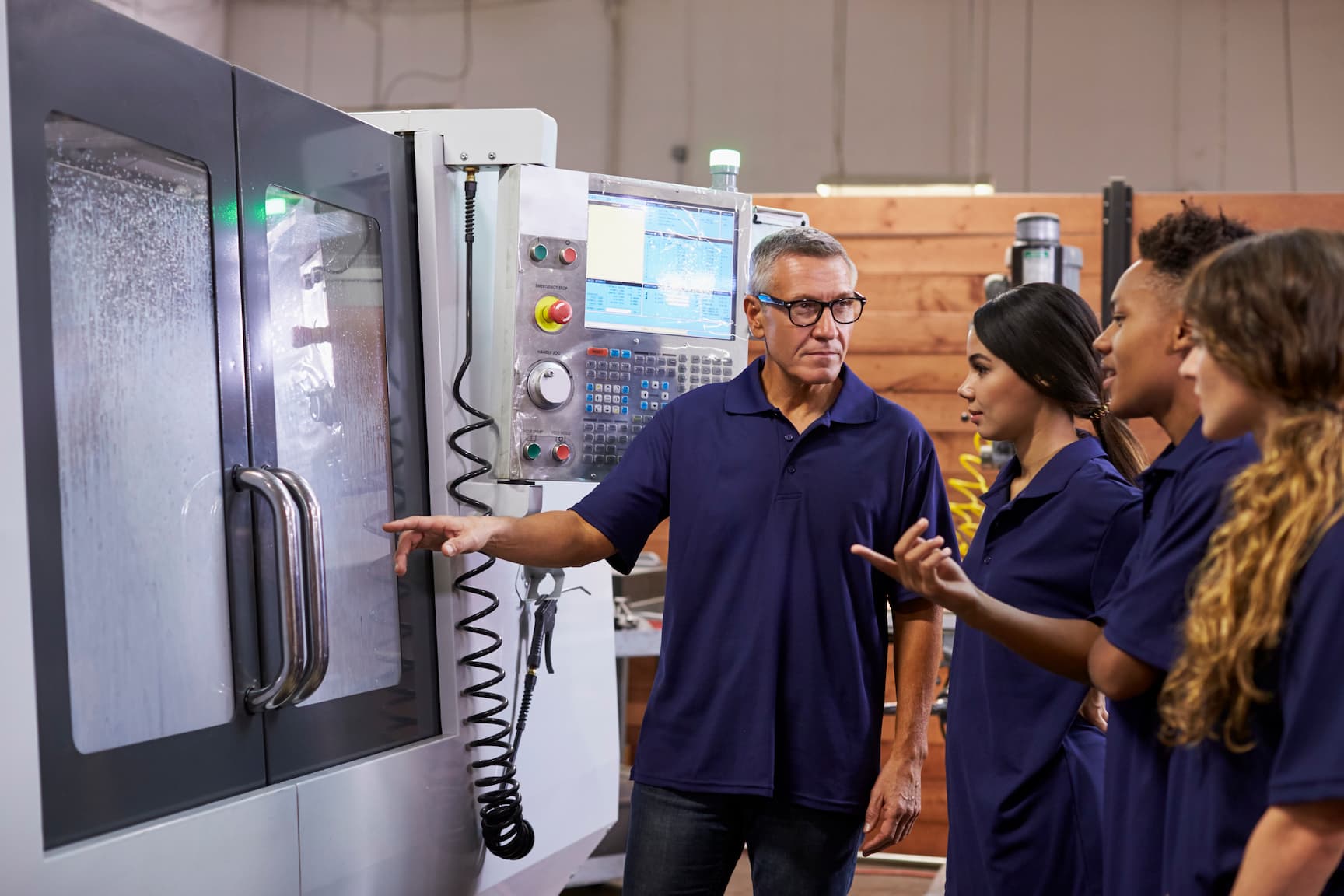
When students enter a well-equipped technical classroom, they can see that skilled trades and manufacturing careers are both hands-on and technology-driven. They learn that these fields need people who can think creatively, work with computers, understand physical systems, and adapt as technology changes.
This exposure does more than prepare students for one occupation. Experience with CAD, CNC machinery, robotics, and project-based learning can create a foundation for careers in manufacturing, engineering, construction, architecture, automotive technology, product development, and many other fields.
Even students who do not ultimately enter manufacturing gain experience in teamwork, planning, precision, and problem-solving.
Schools Cannot Build the Pipeline Alone
Educators play a central role in preparing the next generation, but schools cannot be expected to keep pace with industrial technology without outside support.
Manufacturers, equipment providers, local employers, community colleges, and workforce organizations all have a role to play. Strong partnerships can give educators a clearer understanding of the skills employers need while helping students connect classroom learning with local career opportunities.
These partnerships do not always require a major financial commitment. Manufacturers can invite students and teachers to tour their facilities, share examples of real production challenges, donate usable materials for classroom projects, or provide mentors for robotics and technical teams. They can also support educator training, create internships and job-shadowing opportunities, and work with technical schools and colleges to better align instruction with regional workforce needs.
The most useful partnerships are ongoing rather than transactional. Providing equipment or funding can help, but schools also need training, technical guidance, project ideas, and connections to people currently working in the industry.
Future-Proofing Technical Education to Build Tomorrow’s Workforce
The manufacturing skills gap will not be solved by a single program, company, or school district. It requires a long-term commitment to showing young people what modern manufacturing looks like and giving them meaningful opportunities to participate in it.
That starts by treating technical education as more than a backup option. Manufacturing careers can be creative, well-compensated, and future-facing, and students deserve to see those possibilities early enough to act on them.
By combining traditional craftsmanship with digital design, CNC technology, robotics, and real-world projects, educators can help students develop the creativity, technical judgment, and problem-solving skills modern manufacturing jobs demand. Students can learn not only how to operate equipment, but how to take an idea, refine it, and build something that works.
As schools prepare for another academic year, leaders should evaluate whether their technical programs are aligned with the careers students will encounter after graduation. That means developing relevant curricula, pursuing available grants, and committing sustained resources to hands-on technical education. A strong workforce pipeline begins with a strong foundation in the classroom.

Author: Brandon Bombardo
Brandon Bombardo is Director of Sales and Marketing at ShopSabre, a U.S.-based manufacturer of CNC routers, laser, and plasma cutting machines used by manufacturers, fabricators, and small business owners worldwide. As ShopSabre was founded by his father in 2001, Brandon has spent his career immersed in the CNC industry, working directly with customers to understand how CNC technology can improve production efficiency, precision, and profitability, while helping scale ShopSabre’s commitment to American manufacturing and hands-on customer support. With his deep industry knowledge, Brandon also hosts the Talkin’ Shop with ShopSabre podcast, where he explores CNC technology, manufacturing trends, and the realities of running a modern shop with industry professionals. Brandon is based in the Minneapolis–Saint Paul area.


