

Key Takeaways
- Physical AI robotics replaces written logic with trained examples, which is what lets a robot handle parts that are not identical every time.
- Yaskawa’s Y-NX runs on an NVIDIA controller and is trained in skills and tasks rather than programmed in conventional robot code.
- The target is semi-structured environments, the high-mix low-volume work that four decades of industrial robotics largely could not reach.
- Josh Leath puts the welder shortage at 300,000, the clearest statement of why this matters commercially rather than technically.
- Yaskawa’s ArcWorld cells now span truck trailers, ship structures, structural steel and data center components using linear tracks, parts that never fit a conventional cell.
Physical AI robotics is being sold as a leap in machine intelligence. The more accurate description, and the one Yaskawa gives, is narrower and more useful: robots have always been excellent at repetition and poor at variance, and this attacks the variance.
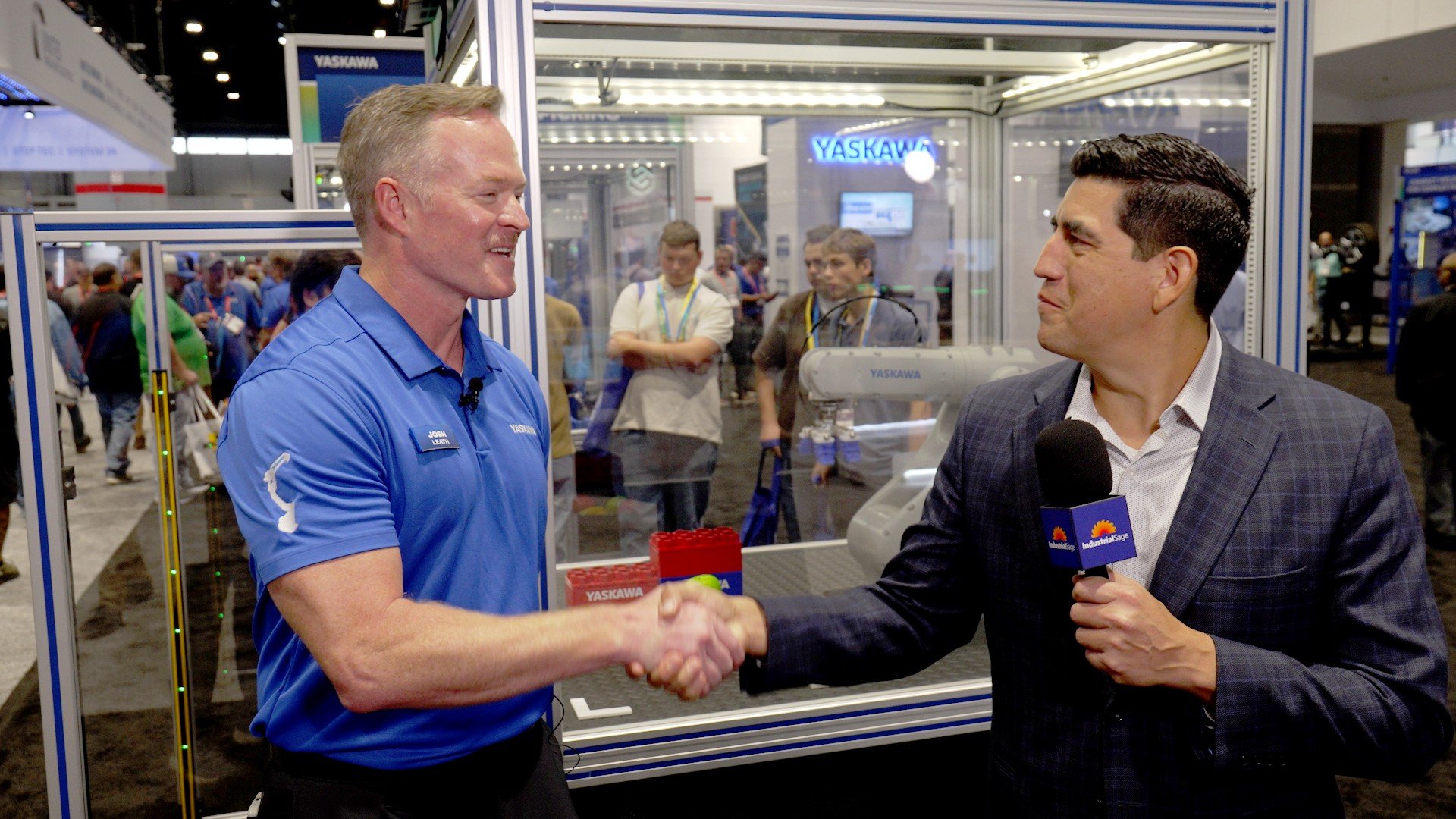
IndustrialSage sat down with Josh Leath of Yaskawa on the show floor at IMTS 2026. Watch the full interview here.
The Forty Year Limitation
Industrial robots have been commercially viable since the 1960s, and the constraint on where they could be used has barely moved. Leath states it plainly.
“Robotics have been very good at very redundant tasks, very repetitive tasks. But if there’s any type of variance in that task, it’s very hard to automate traditionally.”
That single sentence explains the shape of the entire installed base. Automotive automated early and deeply because a body panel is the same body panel a million times. Job shops did not, because the next part is a different part. The robot was never the limiting factor. The requirement that the world hold still was.
“Mainly used for those kind of semi-structured environments, where typically with robotics you have to have something that’s highly repeatable. With a structured environment the robots can be repeatable, but if something’s off, the robot can compensate for it. This, with very basic sensors, can compensate for that.”
Note “with very basic sensors.” The claim is not that the hardware got better. It is that the same sensors feeding a different kind of controller produce a different kind of behavior.
Trained, Not Programmed
Y-NX is built around an NVIDIA controller handling motion and object identification together, and Leath is careful to distinguish it from conventional practice.
“It’s the controller that’s an NVIDIA unit that’s handling all the motion control, identification of objects. You can train it in both skills and tasks. So instead of your typical logic code, it’s a way to broaden the possibilities for robotics. It’s a true model-based robot programming.”
Asked to explain the training, he reaches for fruit, which turns out to be the clearest possible example.
“You have a basic banana. That’s going to be the basic structure, but there’s small bananas, big bananas, brown, green, whatever. So when you’re feeding that imagery into the system, you’re training it, this is still a banana. And then you can add variation to that to say a yellow banana, green banana, brown banana. So if I say I only want yellow bananas, it’s only going to look for yellow bananas.”
Then the layer above it.
“That would be one skill, and then the task could be pick up all the yellow bananas and put them in the bowl. So I’ve trained it what the bowl is. That bowl can move location.”
The movable bowl is the detail worth catching. In conventional programming, the bowl’s position is a coordinate, and moving it breaks the program. Here the bowl is a recognized object, and its location is an input rather than an assumption.
The Same Mechanism Does Inspection
Once the system is recognizing objects rather than following coordinates, quality work falls out of the same capability.
“We’ve had others for inspection that we’ve used it for. So circuit boards, here’s our different types of circuit boards. Here’s what a circuit board looks like when it’s missing a resistor, or here’s one that’s complete and perfect. So it begins to diagnose what is wrong with that product, or I am looking for this specific product in that space.”
Conventional machine vision does this with explicitly programmed rules, which works until the acceptable range of a good part is hard to write down. Training on examples of correct and incorrect sidesteps the specification problem, because nobody has to articulate the rule.
Three Hundred Thousand Welders
The commercial argument is not about capability. Leath goes straight to labor.
“Obviously still with robotics, it’s labor markets, not being able to find the skilled or unskilled help to do something as such as sortation tasks even. On the welding side, you can’t find the skilled welders. There’s 300,000 welder shortage in that space.”
That figure is the pressure behind every physical AI pitch on the show floor. We heard the same constraint from other directions all week: equipment bought so that an aging workforce can still do the job, and software bought so that expertise does not leave with the person who holds it.
What makes Leath’s framing different is where he points the technology. The shortage is not only in welding, it is in anyone willing to do sortation. Conventional automation could already handle the repetitive end of that. The unfilled jobs are disproportionately the variable ones, which is exactly the category robots could not take.
Parts That Never Fit in a Cell
Yaskawa’s established product is ArcWorld, pre-engineered welding cells, and Leath describes extending them to work that was previously out of scope.
“Customers are doing much larger parts, so truck trailer, ship manufacturing, structured steel, data centers, anything where it’s these very large parts that traditionally would not fit in these small cells. We have cells that can span to that now with linear tracks to be able to hit all those weldments.”
Data centers appear in that list alongside shipbuilding, which is consistent with what every other booth reported. The buildout is reaching the heaviest structural fabrication, and the cells are being stretched to meet it.
Built on Feedback, Not Assumptions
Asked what he is proudest of, Leath picks something unglamorous: migrating ArcWorld from an older controller generation to a newer one.
“It was getting out, talking to customers, basing all the changes that we’re making on their feedback, not our assumptions. That continues on as we’re reiterating these ArcWorlds. Just trying to expand that product line based on what the customers truly need, not what we think is a good idea.”
He says a version of that twice in one answer, which usually means someone has watched the alternative happen. For a category now shipping AI-trained controllers, a product manager insisting the roadmap comes from customers rather than from engineering enthusiasm is worth noting.
More from the show floor: the full From the Floor series from IMTS 2026.
About Yaskawa
Yaskawa is a robot OEM headquartered in Kitakyushu, Japan, with its US headquarters in Dayton, Ohio, handling integration for thermal, handling and emerging applications. Its Y-NX physical AI system runs on NVIDIA hardware and is trained on examples rather than conventionally programmed. Learn more at yaskawa.com.
Frequently Asked Questions
What is physical AI in robotics?
Physical AI applies trained models to the control of real machines, so a robot identifies objects and adapts its motion rather than following a fixed program. Yaskawa’s Y-NX runs on an NVIDIA controller handling motion and object identification together, and is trained in skills and tasks instead of written in conventional robot logic.
Why could traditional robots not handle variable work?
Conventional industrial robots execute highly repeatable motions against fixed coordinates. Any variation in part position, size or appearance breaks the assumption the program was built on. That is why automation concentrated in high-volume identical-part production and largely skipped high-mix low-volume work.
How is a physical AI robot trained?
By example rather than instruction. Feeding images of many bananas teaches the system the object, and adding labelled variations teaches it attributes like color. Those become skills, which combine into tasks such as picking only yellow ones and placing them in a bowl whose location can change.
How large is the welder shortage?
Josh Leath of Yaskawa cites a shortage of 300,000 welders. That gap is the commercial driver behind automation aimed at variable work, since the unfilled roles are disproportionately the ones conventional robots could not perform.
Can physical AI be used for quality inspection?
Yes. The same object-recognition capability supports inspection, trained on examples of complete and defective assemblies, such as a circuit board with and without a resistor. It avoids the need to write explicit rules describing every acceptable variation of a good part.
What is ArcWorld?
ArcWorld is Yaskawa’s line of pre-engineered welding cells including safety, positioners and robots. Recent configurations use linear tracks to reach very large weldments such as truck trailers, ship structures, structural steel and data center components that would not fit a conventional cell.

Author: Wes Garrett
Content and Growth Marketing Producer | From Strategy to Execution, Delivering Impactful Media Solutions and Client Success


