

Key Takeaways
- Tribal knowledge in manufacturing is concentrated in people close to retirement, and most plants have no mechanism to extract it before they leave.
- Nick Haase puts less than 60 percent of a frontline worker’s time on the job they are actually there to do. Hugo Dozois-Caouette’s version: the rest goes to documentation and hunting for information, not the wrench.
- Commonly cited industry benchmarks put typical wrench time at 25 to 35 percent, with around 55 percent treated as world class. The problem is measured, not anecdotal.
- Nick Haase’s framing of the data problem: manufacturers are drowning in data but starved for context. A machine reports that it stopped, never why.
- Demand is strongest from data centers and everything that feeds them, with robotics manufacturers close behind.
Tribal knowledge in manufacturing is usually discussed as a culture problem. The two co-founders of MaintainX treat it as an engineering one, and the distinction matters, because you cannot solve a culture problem before the people carrying the knowledge retire.
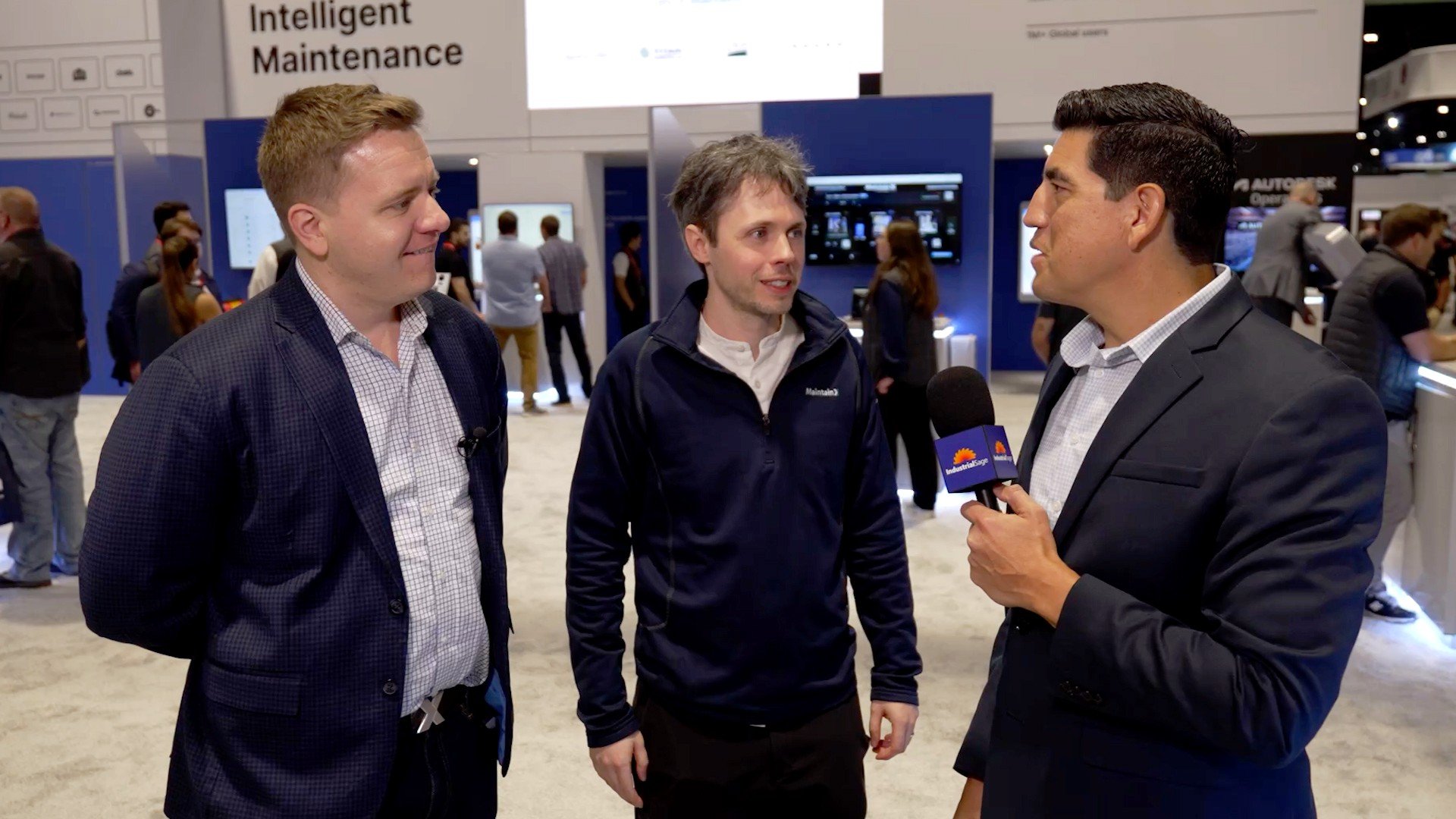
IndustrialSage sat down with Nick Haase and Hugo Dozois-Caouette, co-founders of MaintainX, an Autodesk company, on the show floor at IMTS 2026. Watch the full interview here.
The Problem Has a Name and a Face
Danny Gonzales brought the example rather than the vendors. A maintenance technician at a food and beverage plant, call him Mike, walking the line and tapping on equipment.
“He’s dinging on some things, and he’s listening for a sound. I said, Hey Mike, what are you doing? He’s like, I’m looking to see if these bearings are bad. Well, how did you learn that? And he said, well, I’ve been here for 20 years.”
Twenty years of pattern recognition, entirely undocumented, and no process for handing it to whoever replaces him. Haase does not soften it.
“It’s an existential problem in a lot of ways. Most of the knowledge of how these operations are run is in their head. All the tribal knowledge of how these ecosystems and how these organizations run are heavily dependent on people who are very close to retiring.”
Drowning in Data, Starved for Context
The obvious objection is that plants are more instrumented than ever. Haase’s answer is the sharpest line in the interview.
“Manufacturers are drowning in data but they’re starved for context. We see all this machine data coming off of it, but what does it mean? A machine can tell you if it turned on or off, but it can’t tell you why. Was it an operator error? Was it electrical panel failure? Was it a bearing breakdown?”
That is a precise statement of what sensor data cannot do. Telemetry captures state changes. It does not capture causes, and cause is the thing Mike knows and the historian does not. Every dollar spent instrumenting an asset improves the record of what happened while leaving why untouched.
What the Wrench Time Numbers Actually Say
Dozois-Caouette grounds the cost in a figure practitioners already track.
“60 percent of the time of the technician right now is not spent on the wrench. It’s spent documenting, looking for information, things like that.”
Wrench time is an established maintenance KPI, and the published benchmarks support him. Commonly cited figures, most tracing back to Doc Palmer’s work and to Smith and Mobley, put a typical site at roughly 25 to 35 percent wrench time, with about 55 percent treated as a world class target. Some fleet and facility sources tie the range to software maturity, placing paper-based operations near 20 to 28 percent and well-managed modern systems in the 40s.
Two caveats worth stating. Practitioners disagree on what counts as wrench time, with narrow readings allowing only hands-on tool time and broader ones including troubleshooting and lockout procedures. And much of the published benchmarking is vendor-authored. Treat the numbers as directional.
Directional is enough. Whichever definition applies, the majority of a maintenance technician’s paid day is not spent maintaining anything, and that has been true long enough to have agreed benchmarks.
Capture It Where the Work Happens
If the knowledge is in people’s heads, the question is how it gets out without adding to the 60 percent. MaintainX’s answer is to stop treating documentation as a desk task.
“Voice is a big factor for this, because as you just finish a job, nothing easier than just you can talk to your phone for a few minutes as you’re walking to the next job, describing what happened, what didn’t work well, what worked well. We can index all this data, and then the next time this problem happens two years from now, you can pull from that information directly.”
And for the parts of the job that resist description entirely, including the tapping and listening that Mike never learned from a manual:
“It’s hard to get really good content in an industrial environment. But if you can just go around with an iPhone, you film Mike as he’s doing the repair, and then upload that video, transform it into a procedure directly from what he’s been doing.”
The design decision underneath both is that capture has to happen at the moment of the work, by the person doing it, in under a minute. Anything requiring a technician to sit down later is a system that will be populated badly or not at all.
Built for the Technician, Not the Buyer
Asked how they get adoption on the floor, Haase gives an answer that doubles as a criticism of the category.
“Most of our competitors in the legacy ecosystem thought of the customer as the executive that signs the check. So they built a system that made that guy excited with all these fancy dashboards on a desktop, but the technicians don’t work at a desk. They work on the go, and they need mobile software that is easy and intuitive.”
This is the real adoption mechanic, and it is not a training problem. Dozois-Caouette frames it as a trade the technician has to come out ahead on.
“Sure, tracking information is something his boss wants, but Mike has specific needs. If we can cut into that 60 percent and reduce that, then Mike is more willing to go on the platform. That’s how we get the data.”
The system only receives knowledge if it first gives time back. Software that extracts data without returning anything gets filled in at the end of a shift, badly, which produces a record that nobody trusts and therefore nobody uses.
Where the Demand Is
Asked which verticals moved over the past year, Haase does not hesitate.
“There’s enormous demand right now from data centers. And everything that feeds a data center.”
That phrase is the one to sit with. It is the same chain IndustrialSage has tracked through power transformer lead times, gas turbine capacity, switchgear and the welder shortage. The buildout has now reached the maintenance layer: once the equipment is installed, somebody has to keep it running, and the people who know how are the same cohort heading for retirement.
Dozois-Caouette adds robotics manufacturers, and a warning about why standing still is no longer neutral.
“Competition is harder than ever before. If you don’t do it, your competitor is on top of it, and suddenly what you were doing for the past 50 years doesn’t work anymore.”
More from the show floor: the full From the Floor series from IMTS 2026.
About MaintainX
MaintainX builds work execution and maintenance software for industrial and manufacturing teams, designed around the frontline technician rather than the desktop. Learn more at getmaintainx.com.
Frequently Asked Questions
What is tribal knowledge in manufacturing?
Tribal knowledge is the undocumented operational know-how held by experienced staff, such as recognizing a failing bearing by sound. It is learned on the job and passed informally. MaintainX co-founder Nick Haase calls the dependency existential, because that knowledge is concentrated in workers close to retirement.
What is wrench time and what is a good benchmark?
Wrench time measures the share of a maintenance technician’s day spent actually working on equipment. Commonly cited benchmarks, tracing largely to Doc Palmer and to Smith and Mobley, put a typical site at roughly 25 to 35 percent, with about 55 percent considered world class. Definitions vary and much of the published data is vendor-authored.
Why does machine data not solve the maintenance knowledge problem?
Telemetry records state changes, not causes. As Haase puts it, a machine can tell you it turned on or off but not why, whether that was operator error, an electrical panel failure, or a bearing breakdown. Cause is what the experienced technician knows and the data historian does not.
How can a plant capture knowledge from retiring technicians?
MaintainX argues capture has to happen at the moment of work. That means voice notes recorded walking between jobs, and filming a repair on a phone and converting that footage into a written procedure, rather than asking technicians to document at a desk after a shift.
Why do maintenance software rollouts fail on the floor?
Legacy systems were designed for the executive approving the purchase, producing desktop dashboards for people who do not work at desks. Adoption follows when the software first gives time back to the technician, which means reducing the roughly 60 percent of the day spent on documentation and searching.
Which industries are driving maintenance software demand?
Haase reports the strongest demand from data centers and from the supply chain feeding them, with robotics manufacturers close behind. That matches the broader pattern of the data center buildout reaching successive layers of industrial capacity.

Author: Wes Garrett
Content and Growth Marketing Producer | From Strategy to Execution, Delivering Impactful Media Solutions and Client Success


