

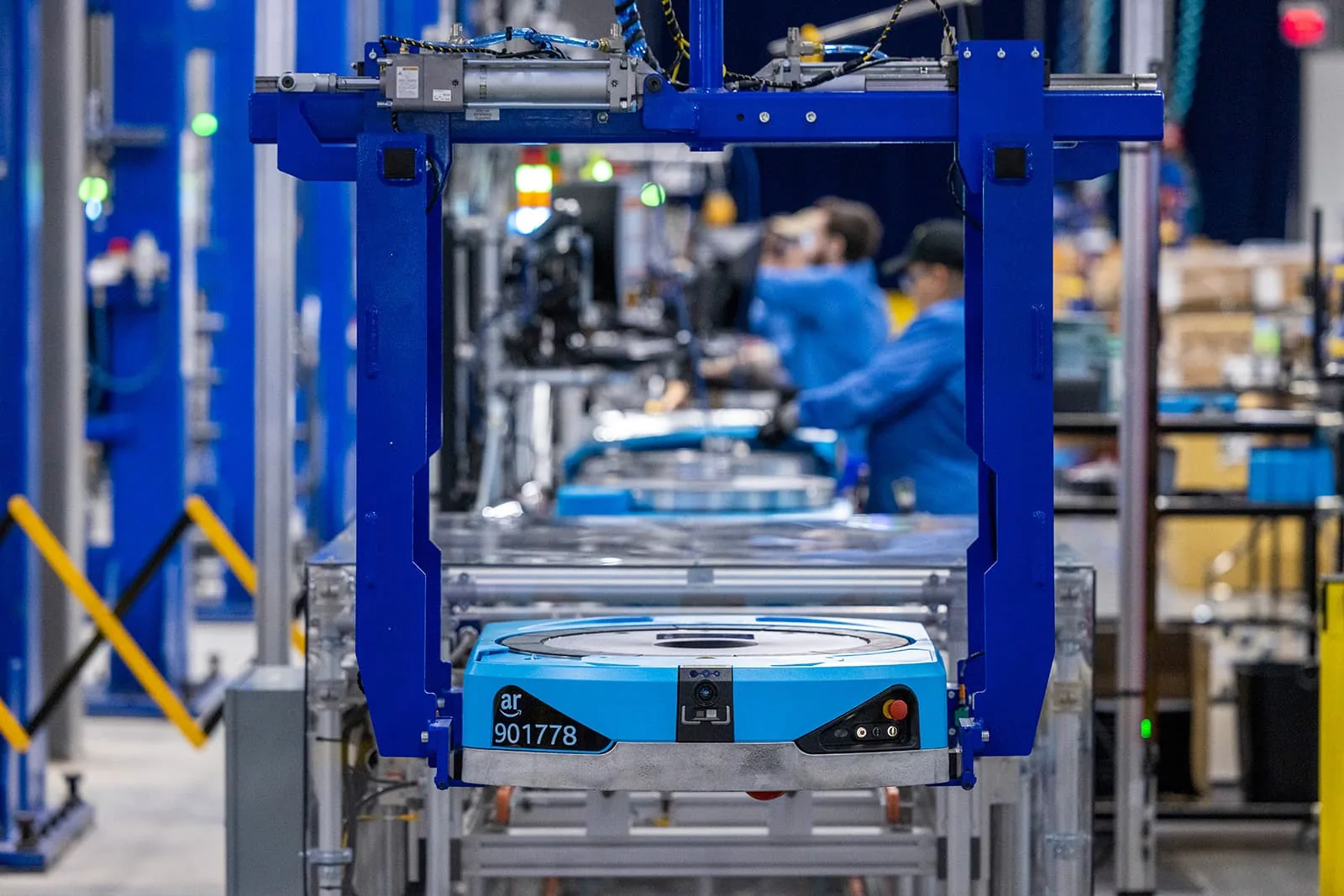
Warehouse automation manufacturing has a new entrant, and it happens to be the industry’s single largest customer. Amazon is spending more than $100 million to build the machines it has spent 14 years buying.
Key Takeaways
- Amazon will invest more than $100 million in a 585,000 square foot plant in Greenwood, Indiana. The site creates 300 jobs at an average salary near $100,000.
- Notably, the site handles advanced fabrication, robotic welding, automated powder coating and final assembly, and it should be operating by 2028.
- Amazon acquired Kiva Systems in March 2012 for $775 million, yet it did not open a dedicated robotics factory until 2021 in Westborough, Massachusetts.
- However, the pace changed sharply in 2026. A multibillion dollar Austin site was announced in August, and Greenwood followed about 5 weeks later.
- Amazon deployed its 1 millionth robot in 2025 across more than 300 facilities, making it the largest industrial mobile robot fleet in the world.
What Amazon Is Actually Building in Greenwood
Currently the facility sits at 1175 Collins Road in Greenwood, Indiana, and it covers roughly 585,000 square feet. Amazon says it will produce the equipment that powers its fulfillment and robotics network across North America.
Specifically, the plant combines advanced fabrication, robotic welding, automated powder coating and final assembly under one roof. Together those are the 4 core processes behind a mobile drive unit, a conveyor frame or a storage pod. In other words, this is not an assembly shop bolting together purchased subassemblies. It is metal in, finished equipment out.
Amazon selected Indiana for its manufacturing workforce, cost structure and logistics access. Furthermore, the 300 jobs carry an average salary of nearly $100,000, which is a manufacturing engineering pay band rather than a fulfillment one. The project is 1 of 5 stories in IndustrialSage Headlines Ep. 34.
Why Warehouse Automation Manufacturing Moving In-House Matters
Until now, Amazon was the demand side of this market. It bought conveyors, sortation systems and storage structures from the same vendors that serve every other large distribution operator.
The warehouse automation market is worth roughly $34 billion in 2026. Moreover, it is growing about 14 percent a year toward $66 billion by 2031. Specifically, Daifuku leads on revenue at about $4.6 billion. Dematic follows at about $3.9 billion under KION Group, then Honeywell Intelligrated at about $1.8 billion.
Consequently, a customer of Amazon’s scale moving even part of its spend in-house changes the addressable market those suppliers are underwriting. Amazon alone operates the world’s largest fleet of industrial mobile robots.
The 9 Year Gap Is the Real Story
In fact, Amazon has owned a robotics company since March 2012, when it paid $775 million for Kiva Systems. For years that work stayed in Massachusetts, inside the legacy Kiva operation in North Reading. However, Amazon did not open a dedicated robotics factory until 2021, in Westborough, at 350,000 square feet.
Then the clock compressed.
| Site | Milestone | Scale |
|---|---|---|
| North Reading, Massachusetts | Kiva acquisition, March 2012 | $775M |
| Westborough, Massachusetts | First dedicated factory, 2021 | 350,000 sq ft |
| Austin, Texas | Announced August 2026 | Multibillion dollar |
| Greenwood, Indiana | Announced September 2026 | 585,000 sq ft |
Nine years passed between owning a robotics company and building a factory for it. By contrast, 5 weeks passed between the last 2 announcements. Greenwood is also two thirds larger than Westborough, so the capacity curve is steepening as well as the announcement curve.
What Changed in the Fleet
Clearly scale is part of the answer. Amazon delivered its 1 millionth robot in 2025 across a network of more than 300 facilities. The company describes it as the largest fleet of industrial mobile robots anywhere.
Software is the less obvious part. Notably, Amazon introduced DeepFleet, a generative AI foundation model that coordinates robot movement, and estimates it improves fleet travel efficiency by about 10 percent. Importantly, a company that controls the coordination layer has a strong reason to control the hardware the layer runs on. Vertical integration tends to follow software advantage rather than precede it.
What It Means for Suppliers
Therefore 3 consequences follow for anyone selling into this category.
First, the largest single buyer is now partly a competitor, which compresses the forecast every automation vendor builds around. Second, Amazon is hiring manufacturing engineers at the $100,000 band in Indiana. That pulls from the same regional talent pool those vendors recruit from. Third, and more encouraging, Amazon is validating domestic production of material handling equipment that has often been imported.
That last point connects to the broader data. As we covered in the August durable goods report, core capital goods orders rose 1.6 percent. The series is tracking 10.6 percent ahead of last year. Projects like Greenwood are what that series is made of, and you can follow the rest on our US Manufacturing Investment Tracker.
Frequently Asked Questions
What is warehouse automation manufacturing?
Generally, warehouse automation manufacturing is the production of the physical equipment used inside distribution centers, including mobile robots, conveyors, sortation systems and storage structures. The global market is worth roughly $34 billion in 2026.
How much is Amazon investing in Greenwood, Indiana?
Overall, Amazon said it will invest more than $100 million in a 585,000 square foot facility at 1175 Collins Road. The site will create 300 skilled manufacturing and engineering jobs at an average salary near $100,000 and should be operating by 2028.
When did Amazon buy Kiva Systems?
Amazon acquired Kiva Systems in March 2012 for $775 million. However, it did not open a dedicated robotics manufacturing factory until 2021, in Westborough, Massachusetts.
How many robots does Amazon operate?
In total, Amazon deployed its 1 millionth robot in 2025 across more than 300 facilities. The company describes it as the largest fleet of industrial mobile robots in the world.
Who are the largest warehouse automation suppliers?
In short, Daifuku leads at about $4.6 billion by revenue. Dematic follows at about $3.9 billion under KION Group, then Honeywell Intelligrated at about $1.8 billion. Swisslog and Jungheinrich are also major participants.
Why is Amazon manufacturing its own robots?
Amazon now controls the software layer that coordinates its fleet through its DeepFleet model, which it estimates improves travel efficiency by about 10 percent. Therefore controlling the hardware that layer runs on gives it tighter design iteration and supply certainty.

Author: Wes Garrett
Content and Growth Marketing Producer | From Strategy to Execution, Delivering Impactful Media Solutions and Client Success


