

Key Takeaways
- The HyperScan SR, pre-released at IMTS, is an optical tracking hand scanner that runs completely wireless anywhere within the tracker’s field of view.
- It projects 34 laser lines. Trevorrow is open that wireless required a tradeoff: the larger model in the family runs 81 laser lines and generates more data than can be transmitted over the air.
- Cost of poor quality is commonly estimated at 5 to 30 percent of gross sales in manufacturing, with figures attributed to the American Society for Quality putting it at 15 to 20 percent of sales at many manufacturers.
- Hexagon’s equipment helped an EV startup validate parts before a prototype vehicle existed, reaching full production faster. The vehicle is the Slate Truck, now targeted for production at a converted Indiana plant.
- Trevorrow’s argument for metrology is not accuracy, it is retention: “How does that guy know how to correct that bend, because he’s done it for so long?”
Wireless 3D scanning sounds like a convenience upgrade, the metrology equivalent of cutting the cord on a pair of headphones. On a shop floor it is closer to a change of venue, because a measurement device that has to stay tethered is a measurement device the part has to travel to, and parts that travel to the quality room get measured after the fact rather than during.
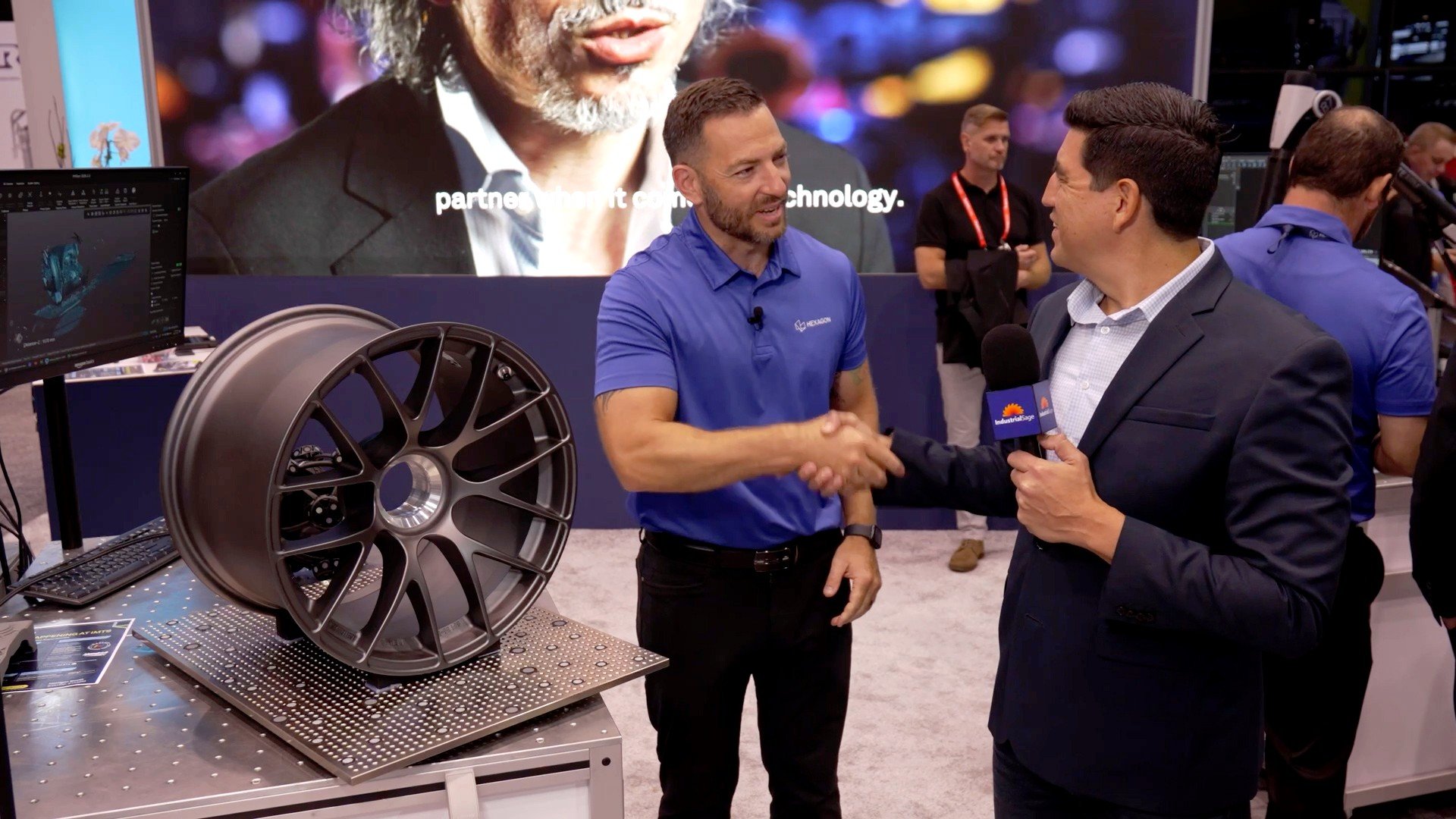
IndustrialSage sat down with Jeremy Trevorrow, Senior Sales Manager at Hexagon, on the show floor at IMTS 2026. Watch the full interview here.
A Scanner With Nothing Attached to It
Trevorrow starts with how Hexagon approaches a booth visit, which is a sales philosophy worth repeating.
“When customers come into Hexagon’s booth, it’s more or less we want to understand what they’re doing, what they’re making, and what their measurement tolerances are, so that we can best make a recommendation. It’s not so much a hammer and nail situation for us. We truly can guide them into the best solution for them.”
The product being shown is new enough that it was not on sale yet.
“Here we have the newest product in the Hyperscan family, which is optical tracking hand scanner. This is the HyperScan SR, which actually we’re doing a pre-release here at the show. It doesn’t actually come out till next month. But the unique thing about this system is that we did this completely wireless. Anywhere in the tracker’s field of view, this scanner can operate. So I don’t have any cords hanging from this. There’s no trip hazards, things of that sort.”
It projects 34 laser lines in what the camera reads as a fishnet, so an operator sweeps a surface and collects it quickly.
What makes the answer credible is that he does not pretend the wireless came free.
“To do the wireless portion of this, to make it that way, we did have to throttle down the scanner a little bit. So this is going to be more of the entry level one. This one has 34 laser lines. The big brother to this has 81 laser lines. Significantly more data, so much so that we can’t necessarily transmit it wirelessly.”
That is a real engineering constraint stated plainly: the radio link, not the optics, sets the ceiling. A denser scanner exists in the same family for people who need the density and can accept a cable.
Why the Cord Was the Point
The reason to care is where measurement happens. Precision metrology has traditionally lived in a controlled room, with parts carried to it, which puts a queue and a walk between making a part and knowing whether it is right. Anything that moves measurement to where the work is compresses that loop.
“This allows our customers now to have the versatility to just grab the system, go out on the shop floor, and then just scan away.”
It is the same structural idea as simulating a program before it reaches the machine or eliminating a setup operation: the value is not in the measurement itself but in how early you get it. A dimension checked during the run can change the run. The same dimension checked afterwards can only decide what to scrap.
Catching It Before It Becomes Ten Thousand Parts
Asked what he is proudest of, Trevorrow describes a relationship that started before there was a product to measure.
“We had some team members that I’ve worked with in the past. They went and worked for a new startup company. They came out to us before there was even a prototype of the vehicle or anything of that sort, and kind of just wanted to build a relationship with us to use our technology to help make sure that they were building the best product for their customers.”
The vehicle turned out to be the Slate Truck, the compact electric pickup Slate Auto is preparing to build at a converted former printing plant in Warsaw, Indiana, a site targeted for roughly 2,000 jobs and a capacity on the order of 150,000 vehicles a year.
What the metrology did is specific to the hardest phase of any new program.
“You’re validating in the prototype side. As you’re ramping up with production, you want to make sure that your production’s producing a good part. You want to reduce scrap, save costs, things of that sort. So by trusting our measurement equipment, they were able to identify their manufacturing processes, make corrections early, and then get into full production at a faster rate.”
The economics behind “make corrections early” are not subtle. Cost of poor quality is commonly put at 5 to 30 percent of gross sales across manufacturing and service businesses, and figures attributed to the American Society for Quality place quality-related costs at 15 to 20 percent of sales at many manufacturers. Those are wide ranges because every plant counts them differently, but even the bottom of the range is larger than most operating margins.
A process error found during ramp-up costs a fixture change. The same error found at rate costs every part made since. For a company going from no prototype to a production line in a repurposed building, the difference between those two is the difference between launching and not.
The Witchcraft Problem
The last answer is the one worth the whole interview, and it is not about scanners at all.
“We say sometimes in the production world, talk about tube bending and things, there’s always the master of that craft. But when we use metrology equipment, it kind of takes some of the historical knowledge out of it. Sometimes people can call it witchcraft. How does that guy know how to correct that bend, because he’s done it for so long? Well, now if we start to lose those experts in the industry, we can digitally collect this information, make corrections in the production side of things, and it just speeds up everything.”
Tube bending is a well-chosen example because springback is genuinely hard to predict. How far a bent tube relaxes depends on the alloy, the wall thickness, the temper of that particular lot, the die, the mandrel and the radius, and the compensation that produces a correct part is usually arrived at empirically by somebody who has bent thousands of them. That person cannot write down what they know, because most of it was never in words to begin with.
Measurement converts that into something transferable. If you can capture the deviation precisely and repeatedly, the correction stops being a judgment and becomes a number in a process, which means it survives the retirement of the person who used to supply it.
That reframes a scanner from a quality tool into a knowledge tool, and it puts Hexagon in the same conversation as everyone else at the show worrying about expertise walking out the door. It is also the same argument for taking variation out of skilled manual setup: not that the craftsman is wrong, but that the business cannot depend on there being another one.
More from the show floor: the full From the Floor series from IMTS 2026.
About Hexagon
Hexagon is a manufacturing intelligence company whose metrology division builds coordinate measuring machines, laser trackers, portable measuring arms and 3D scanning systems for dimensional inspection across automotive, aerospace and general manufacturing. Learn more at hexagon.com.
Frequently Asked Questions
What is a wireless 3D scanner and why does it matter?
It is a handheld optical scanner that operates without a cable anywhere inside its tracker’s field of view. The practical gain is location: precision measurement has traditionally required bringing parts to a controlled room, and a cordless scanner lets an operator measure out on the shop floor during production rather than after it.
What is the Hexagon HyperScan SR?
An optical tracking hand scanner pre-released at IMTS 2026, projecting 34 laser lines and operating completely wirelessly within the tracker’s field of view. Hexagon positions it as the entry point of the HyperScan family.
What is the tradeoff with a wireless scanner?
Data density. Jeremy Trevorrow of Hexagon says going wireless required throttling the scanner down to 34 laser lines, because the larger 81 line model in the family generates more data than can be transmitted over the air. The radio link, not the optics, sets the limit.
What does poor quality cost a manufacturer?
Estimates of cost of poor quality commonly range from 5 to 30 percent of gross sales, and figures attributed to the American Society for Quality put quality related costs at 15 to 20 percent of sales at many manufacturers. Definitions vary widely between plants, but even the low end exceeds most operating margins.
Why is measurement most valuable during production ramp-up?
Because a process error caught during ramp-up costs a correction, while the same error caught at full rate costs every part produced since it started. Validating the process early is how a new program reaches full production faster and with less scrap.
How does metrology capture craft knowledge?
Skills like compensating for springback in tube bending are learned empirically over thousands of parts and are difficult to write down. Measuring the deviation precisely and repeatedly turns that judgment into a number inside a documented process, so the correction survives the retirement of the person who used to supply it.

Author: Wes Garrett
Content and Growth Marketing Producer | From Strategy to Execution, Delivering Impactful Media Solutions and Client Success


