

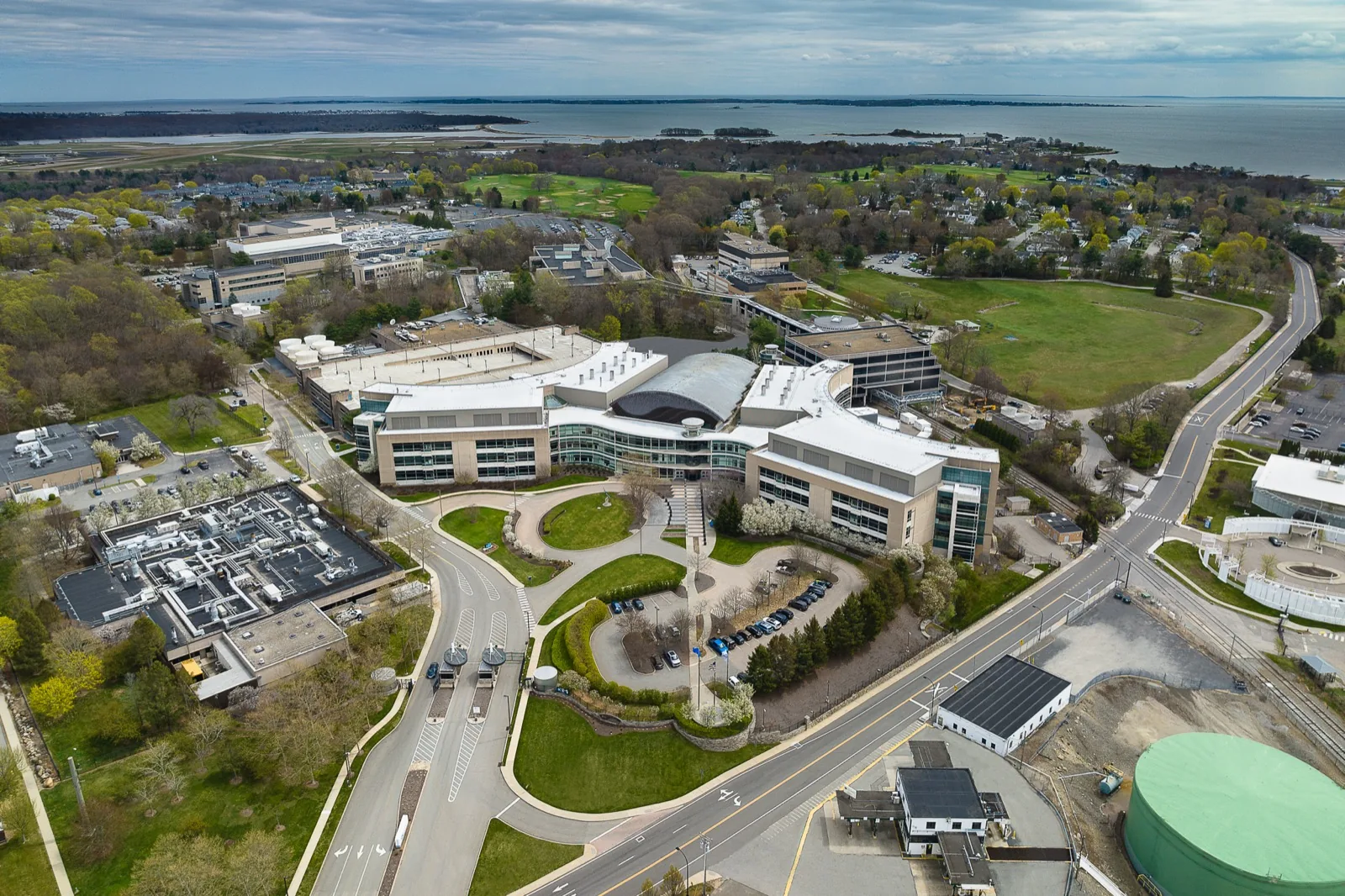
The Pfizer Groton manufacturing technology center is a $650 million plant going up without a dollar of state incentive money. In 2026, that is the unusual part.
Key Takeaways
- Pfizer will invest $650 million over 5 years in a new Manufacturing Technology Center at its Groton, Connecticut research campus.
- The facility covers roughly 220,000 square feet on a 175 acre campus Pfizer has operated since 1959.
- Specifically, it will produce clinical active pharmaceutical ingredients and finished drug products for Pfizer sponsored trials worldwide.
- Construction starts in the second quarter of 2027, and operations are targeted for mid 2031.
- Notably, Connecticut has provided no financial incentives, according to AdvanceCT president and chief executive John Bourdeaux.
- Also, there is no net new job figure. Pfizer will consolidate employees already working in other buildings on the Groton campus.
- Pfizer phased out commercial manufacturing at Groton by the end of 2008, so this returns a production capability the site lost.
- Consequently, the project reads as a proximity decision rather than a site selection contest.
AdvanceCT, Connecticut’s nonprofit economic development organization, announced the project in early November 2026. Pfizer has run the Groton campus since 1959, and it remains one of the company’s largest research sites. In 2025 Pfizer employed roughly 4,000 people there and was the town’s second largest taxpayer. The new building goes on ground Pfizer already owns, staffed by people Pfizer already employs.
The state has not provided any financial incentives for the project.
John Bourdeaux, President and Chief Executive, AdvanceCT
What the Pfizer Groton manufacturing technology center will produce
The output is clinical rather than commercial, and the distinction decides almost everything about how the plant is built and run. Clinical active pharmaceutical ingredients, or APIs, are the drug compounds themselves, made in the quantities a trial consumes rather than the quantities a market consumes. The center will also produce the finished dose forms used in Pfizer sponsored studies worldwide.
| Detail | Figure |
|---|---|
| Investment | $650 million over 5 years |
| Size | Approximately 220,000 square feet |
| Location | Groton, Connecticut, on a 175 acre campus |
| Output | Clinical APIs and finished drug products for trials |
| Construction start | Second quarter 2027 |
| Operational | Mid 2031 |
| State incentives | None provided |
| Net new jobs announced | None. Staff consolidate from existing campus buildings |
That 4 year gap between groundbreaking and startup is normal for regulated pharmaceutical construction rather than a sign of hesitation. Qualification, validation and regulatory inspection consume a large share of the schedule after the building is physically complete. In short, the concrete is the fast part.
Why manufacturing is returning to a research campus
Pfizer phased out commercial manufacturing at Groton by the end of 2008. Since then the site has been a research and development campus. The Pfizer Groton manufacturing technology center does not reverse that decision, because clinical supply is a different business from commercial supply. However, it does put production back on a site that had been design only for nearly 2 decades.
The logic is proximity. A clinical API campaign is typically a one off. It makes a few kilograms on a process that has never run at that scale. The deadline comes from a trial start date rather than a sales forecast. When the chemists who developed the route sit in a building across the parking lot from the people running it, problems get solved in hours. When the campaign runs at a contract manufacturer 3 time zones away, the same problem costs a week. Therefore the real product of this facility is speed through the clinic.
The incentive question is the story
Nearly every large manufacturing announcement we have covered this year arrived with a state or local package attached. Tax abatements, infrastructure credits, training grants and sometimes cash have become the assumed price of entry. This project had none of that. Bourdeaux of AdvanceCT confirmed the state provided no financial incentives. One caveat is worth stating plainly: Pfizer could still apply, and simply has not done so.
There is a straightforward reason why no package was needed. This was never a competitive site selection. Pfizer owns the land, operates the campus, employs the people and needs the plant next to its chemists specifically. Connecticut had no rival to outbid, so it paid nothing. Furthermore, that is the general rule hiding inside this announcement: incentives are the price of mobility, and a project tied to an existing campus is not mobile.
For economic development professionals, the practical read is that a company’s existing footprint is the strongest predictor of where expansion lands, and it costs the least to win. We have watched the opposite case play out repeatedly, including when Houston drew a second multibillion dollar pharmaceutical plant.
One open question Pfizer has not answered
At least one outlet has reported that Pfizer declined to confirm a related point. The question is whether the Pfizer Groton manufacturing technology center counts toward the $70 billion research, development and capital commitment the company agreed with the US government in 2025. Only one source has raised it, and Pfizer has not addressed it publicly, so treat it as unresolved. Nevertheless, it matters for anyone tracking how much of that $70 billion represents genuinely incremental spending versus projects a company would have funded anyway.
What it means for pharmaceutical manufacturing in the US
Domestic pharmaceutical capacity has been under direct policy pressure since the Section 232 tariff action. We covered it in detail in what importers needed to do before the September 29 deadline. Most of the response has been commercial capacity: fill finish lines, API plants and large campuses aimed at products already approved.
The Pfizer Groton manufacturing technology center sits on the other side of that line. Clinical capacity is the quieter half of the same problem. A drug approved in 2031 has to be made somewhere in 2028 to get through trials. That supply chain has leaned heavily on contract development and manufacturing organizations, many of them outside the United States. Consequently a 220,000 square foot clinical plant in Connecticut is a smaller headline than a billion dollar commercial campus. It is arguably a more durable one, because it sits upstream of every product the company has not launched yet.
For suppliers, the equipment list is specific. It covers reactors and isolators at kilo and pilot scale, chromatography and filtration skids, single use systems, clean utilities, environmental monitoring and serialization for clinical labeling. Moreover, the qualification workload between 2029 and 2031 is substantial contract work on its own, separate from the construction scope. Connecticut’s medical device and precision machining base will see the same pattern we described in the Section 232 medical device tariff coverage.
Frequently asked questions
How much is Pfizer investing in the Groton manufacturing technology center?
$650 million, spread across 5 years. The facility covers roughly 220,000 square feet on Pfizer’s existing 175 acre Groton, Connecticut campus.
What will the Pfizer Groton manufacturing technology center make?
Clinical active pharmaceutical ingredients and finished drug products for Pfizer sponsored clinical trials worldwide. It is clinical supply rather than commercial production.
When will the facility open?
Construction begins in the second quarter of 2027, and operations are targeted for mid 2031. The long gap reflects the qualification and regulatory validation that follows physical construction in pharmaceutical facilities.
How many jobs will the project create?
Pfizer has not announced net new jobs. Instead, it will consolidate employees already working in other buildings across the Groton campus into the new center. Pfizer employed roughly 4,000 people at Groton in 2025.
Did Connecticut give Pfizer incentives for the project?
No. John Bourdeaux, president and chief executive of AdvanceCT, said the state provided no financial incentives. Pfizer could still apply for them, but it has not done so.
Why is Pfizer building manufacturing on a research campus?
Proximity. Clinical manufacturing campaigns are small, novel and schedule critical. Having the chemists who developed a process in the same place as the plant running it shortens the time from development to trial. Pfizer had phased out commercial manufacturing at Groton by the end of 2008.
Track the capital
Pharmaceutical manufacturing investment has been one of the most active categories of 2026. Follow the running total in our US Manufacturing Investment Tracker. Then see the full lineup in IndustrialSage Headlines Episode 37, and keep up with daily reporting in our manufacturing news section.
Primary sources: Pharma Manufacturing’s report on the announcement and AdvanceCT.

Author: Wes Garrett
Content and Growth Marketing Producer | From Strategy to Execution, Delivering Impactful Media Solutions and Client Success


