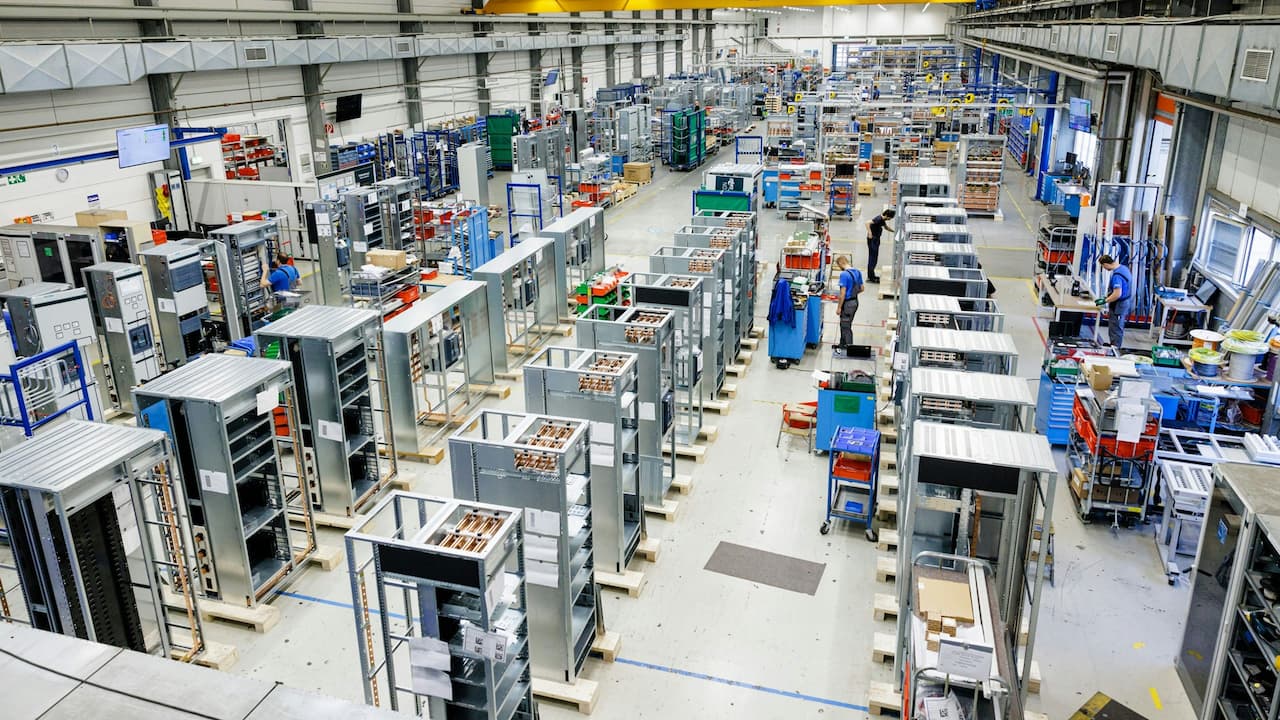
Switchgear lead times have become the quiet constraint on American industrial expansion. Everyone tracks chip fabs and data center announcements. Almost nobody tracks the breakers, switchboards and distribution gear required to energize any of it, and that equipment now takes well over a year to arrive.
Key Takeaways
- Medium voltage switchgear runs roughly 52 to 80 weeks in the 15kV class, against about 24 weeks before the pandemic.
- 38kV equipment can reach 78 to 104 weeks, which is close to two years.
- Siemens will invest at least $185 million in a 550,000 square foot plant in Jackson County, Georgia, adding more than 1,400 jobs.
- The plant builds low voltage electrical components for power distribution, which is precisely the constrained category.
- Construction begins November 2026, with roughly three years to full buildout and hiring from 2027.
- Data centers are projected to drive about 68 percent of U.S. load growth through 2030.
- Transformers and generators are worse. Generator step-up units above 50 MVA reach 100 to 150 weeks or more.
What Switchgear Lead Times Look Like in 2026
Procurement data published in June 2026 by Terrapin Construction Group, drawn from active manufacturer slot reservations, puts medium voltage switchgear in the 15kV class at 52 to 80 weeks. Higher voltage classes run longer still, with 38kV equipment reaching 78 to 104 weeks.
For context, comparable equipment arrived in roughly 24 weeks before the pandemic. Consequently, a project team that treated switchgear as a routine purchase order is now looking at a delay measured in seasons rather than weeks.
| Equipment | 2026 lead time | Historical baseline |
|---|---|---|
| Medium voltage switchgear, 15kV | 52 to 80 weeks | About 24 weeks |
| Medium voltage switchgear, 38kV | 78 to 104 weeks | About 24 weeks |
| Pad mount transformers, 0 to 5 MVA | 40 to 65 weeks | About 8 weeks |
| Substation transformers, 5 to 50 MVA | 75 to 110 weeks | Not stated |
| Generator step-up, above 50 MVA | 100 to 150+ weeks | Not stated |
| Diesel generators, above 3,000 kW | 90 to 110 weeks | About 20 weeks |
| UPS, 500 to 1,500 kVA | 30 to 48 weeks | Not stated |
These figures align with IndustrialSage’s earlier reporting, which found power transformer lead times averaging 128 weeks and generator step-up units at 144 weeks, with prices up 77 percent since 2019.
Siemens Adds 1,400 Georgia Jobs to Widen the Bottleneck
Siemens will invest at least $185 million in a plant of roughly 550,000 square feet at 580 Raco Parkway in Jackson County, Georgia, near Pendergrass and about 60 miles northeast of Atlanta. The Office of Governor Brian Kemp announced the project on August 7, 2026. Moreover, the facility is expected to employ more than 1,400 people.
Once complete, the plant will build low voltage electrical components for power distribution. Notably, that is the exact category under strain. Siemens expects construction to begin in November 2026, with roughly three years to full buildout and hiring from 2027.
Georgia was a natural choice for our next manufacturing investment.
Barry Powell, North America President, Siemens Electrical Products
Governor Kemp framed it in trade terms, calling the plant “another testament to the strong economic partnership between our state and Germany.” However, one caveat belongs on the record. The project remained subject to final approvals, and state incentive negotiations were still active at announcement.
Siemens already employs more than 1,700 people in Georgia across two plants and six offices. In addition, it operates 25 manufacturing sites across the United States.
Why Switchgear Lead Times Got This Bad
The cause is not a single shock. Instead, several demand sources arrived at once: data center construction, battery energy storage, grid modernization, broad electrification and reshored manufacturing. Each one needs the same breakers, switchboards and distribution gear.
Meanwhile, the supply side could not follow quickly. Building switchgear capacity means new plants, tooling and trained assembly and test technicians. Therefore capacity arrives in years, while demand arrived in quarters.
The scale of the mismatch explains the persistence. Data centers alone are projected to account for roughly 68 percent of U.S. load growth through 2030, and the electrical equipment market serving them is expected to expand from about $20 billion in 2026 to $65 billion by 2030. In short, nobody is going to grow into that with overtime.
The Constraint Is Bigger Than Switchgear
Switchgear is the visible symptom of a wider problem. Substation class transformers between 5 and 50 MVA run 75 to 110 weeks. Generator step-up units above 50 MVA reach 100 to 150 weeks or more, against roughly eight weeks for pad mount units before the pandemic.
Generators show the same pattern. Large diesel units above 3,000 kW run 90 to 110 weeks, where they once shipped in about 20 weeks. Similarly, gas turbine capacity has become its own bottleneck, which we covered in our analysis of gas turbine manufacturing capacity.
Taken together, the pattern is consistent: anything that moves or converts large amounts of electricity is now the long pole in the schedule.
What Buyers Should Do About Switchgear Lead Times
Four practices separate teams that hold schedule from teams that slip. First, reserve factory slots before the design is finished, because a slot is worth more than a finalized drawing. Second, standardize on configurations the manufacturer already builds, since custom arrangements go to the back of the queue.
Third, sequence procurement by lead time rather than by construction order. Long lead electrical equipment should be bought before items that can be sourced in a month. Finally, treat electrical equipment as the schedule driver in the master plan, not as a late line item.
Announced domestic capacity, including the Siemens plant, will eventually ease the picture. Even so, buildouts finishing around 2029 do not help a project energizing in 2027. For a broader view of where this capital is landing, see our US Manufacturing Investment Tracker, or follow developments in our manufacturing and industrial news section. The full breakdown appears in IndustrialSage Headlines Episode 31.
Frequently Asked Questions
How long are switchgear lead times in 2026?
Medium voltage switchgear in the 15kV class runs roughly 52 to 80 weeks, and 38kV equipment can reach 78 to 104 weeks, according to procurement data published by Terrapin Construction Group in June 2026. Pre-pandemic, comparable equipment arrived in about 24 weeks.
Why did switchgear lead times get so long?
Demand from data centers, battery storage, grid modernization, electrification and reshoring arrived faster than the manufacturing base could expand. Adding capacity requires new plants and trained workers, which takes years rather than quarters.
What is Siemens building in Georgia?
A plant of roughly 550,000 square feet at 580 Raco Parkway in Jackson County, Georgia, near Pendergrass. Siemens will invest at least $185 million and expects to employ more than 1,400 people building low voltage electrical components for power distribution.
When will the Siemens Georgia plant open?
Construction is expected to begin in November 2026, with full buildout taking roughly three years and hiring starting in 2027. The project remained subject to final approvals and active incentive negotiations at announcement.
Are transformers and generators affected too?
Yes, and in some cases worse. Substation class transformers between 5 and 50 MVA run 75 to 110 weeks, generator step-up units above 50 MVA reach 100 to 150 weeks or more, and large diesel generators above 3,000 kW run 90 to 110 weeks.
How much of US electricity demand growth comes from data centers?
Data centers are projected to account for roughly 68 percent of U.S. load growth through 2030. The electrical equipment market serving those facilities is expected to grow from about $20 billion in 2026 to $65 billion by 2030.
What can buyers do about long switchgear lead times?
Reserve factory slots before design is final, standardize on configurations the manufacturer already builds, order long lead items first, and treat electrical equipment as the schedule driver rather than a late procurement item.

Author: Wes Garrett
Content and Growth Marketing Producer | From Strategy to Execution, Delivering Impactful Media Solutions and Client Success